
It’s the last week of the month, and a QS at a mid-size contractor is pulling numbers from three spreadsheets, cross-referencing subcontract values against invoice totals, and trying to answer one question from the director: “Are we still making money on this job?”
That question – will this project finish in profit? – is what construction forecasting exists to answer. This guide explains what construction forecasting is, how it differs from estimating and budgeting, what data feeds a reliable forecast, why commitment tracking matters, and how software replaces the month-end scramble.
What is construction forecasting?
A good forecast brings together:
| Input | What it is | Why it matters |
|---|---|---|
| Committed costs | Subcontracts awarded, POs raised | Money you’re obligated to spend – even if no invoice has arrived yet |
| Actual costs | Invoices received and paid | Confirmed spend to date – backward-looking but certain |
| Forecast remaining | Estimates of uncommitted work | The uncertain portion – shrinks as more packages are let |
| Variations | Approved and anticipated changes | Affect both income and cost sides of the forecast |
| Contract value | What the client owes you | Including agreed changes – defines your income ceiling |
When these are combined, you get two critical numbers: forecast final cost and forecast margin. Those numbers drive every commercial decision on the project.
Why forecasting matters for contractors
Construction operates on thin margins. A typical main contractor works on 5-10% net margin. A 3% forecast error can wipe out the profit on a job entirely – and you won’t know until it’s too late to act.
Forecasting gives you time. Time to renegotiate, re-procure, value-engineer, or at minimum communicate a problem to your client before it becomes a dispute. Without forecasting, you’re managing projects on gut feel and historic invoices.
"We wanted to know before a project finished whether we were going to make a profit or not. Planyard has allowed us to do that. We can see exactly which jobs are profitable and which ones are not and can make changes on the go."
Read more
The contractors who forecast well share common traits: they know their cost position in real time, they track commitments (not just invoices), and they update their forecasts when things change – not at month-end when the data is already stale.
Budget vs forecast: what’s the difference?
Your budget is the plan you set at tender. It’s what you expected the project to cost when you won it. It doesn’t change (unless you formally revise it).
Your forecast is your current best prediction of what the project will actually cost. It changes every time new information arrives – a subcontract comes in over budget, a variation is instructed, materials prices shift.
The gap between budget and forecast is your variance. That variance tells you whether you’re on track or heading for trouble. A forecast that matches the budget is good news. A forecast that exceeds it needs action – and the earlier you see it, the more options you have.
The role of committed costs in forecasting
This is where most forecasting goes wrong. Traditional cost reporting only shows you what’s been invoiced. But the moment you award a subcontract or raise a purchase order, your cost position has changed – even though your bank balance hasn’t.
Consider a project with a £1M budget. You’ve let subcontracts totalling £700K but only been invoiced £200K so far. A report based on invoices shows 20% spent – looks fine. A forecast based on commitments shows 70% committed – which tells you a completely different story about how much budget remains.
"We can spot the budget risks several months in advance and have a real-time forecast for end costs and profitability."
Commitment-based forecasting is the single biggest improvement most contractors can make to their financial visibility. It’s the difference between knowing your position today and discovering it three months too late. For a deeper explanation, read why commitments matter for forecasting.
What does a good forecasting process look like?
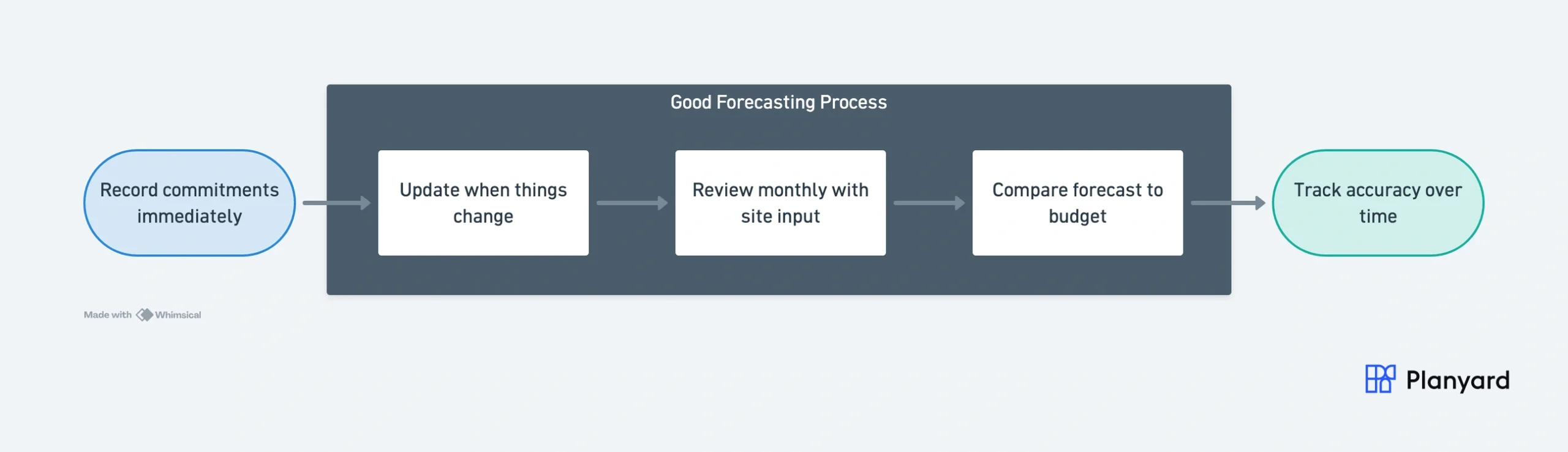
A reliable forecasting process doesn’t require heroic effort from your QS team. It requires discipline in how you handle project data day to day:
- Record commitments immediately. Every subcontract award and PO gets logged against the relevant budget line on the day it’s agreed.
- Update when things change. Variations, scope changes, price adjustments – the forecast reflects them as they happen, not at month-end.
- Review monthly with site input. The QS or commercial manager reviews each trade heading with input from the project team on what’s still to come.
- Compare forecast to budget. Highlight variances. Investigate the big ones. Decide whether action is needed.
- Track accuracy over time. After project completion, compare final outturn to forecast at each stage. Learn where your forecasts drift.
"With Planyard, the financial data is live, meaning you have a real-time view of where the project stands at any moment. When I was relying on Excel, I could only manage that kind of insight once a month. The transition from monthly snapshots to a live dashboard has completely changed how we monitor our project health."
Read more
Who needs construction forecasting?
If you’re running more than one or two projects simultaneously, you need a forecasting process. The question is whether you do it well or badly – not whether you do it at all.
Forecasting is particularly critical for:
- Main contractors managing multiple packages and subcontractors per project
- Specialist subcontractors growing beyond 3-4 live jobs where the MD can hold it all in their head
- Companies using Xero or Sage for accounting but lacking project-level cost visibility
- Any contractor who’s been surprised by a project outcome – forecasting is how you stop that happening again
Why spreadsheets fail at forecasting
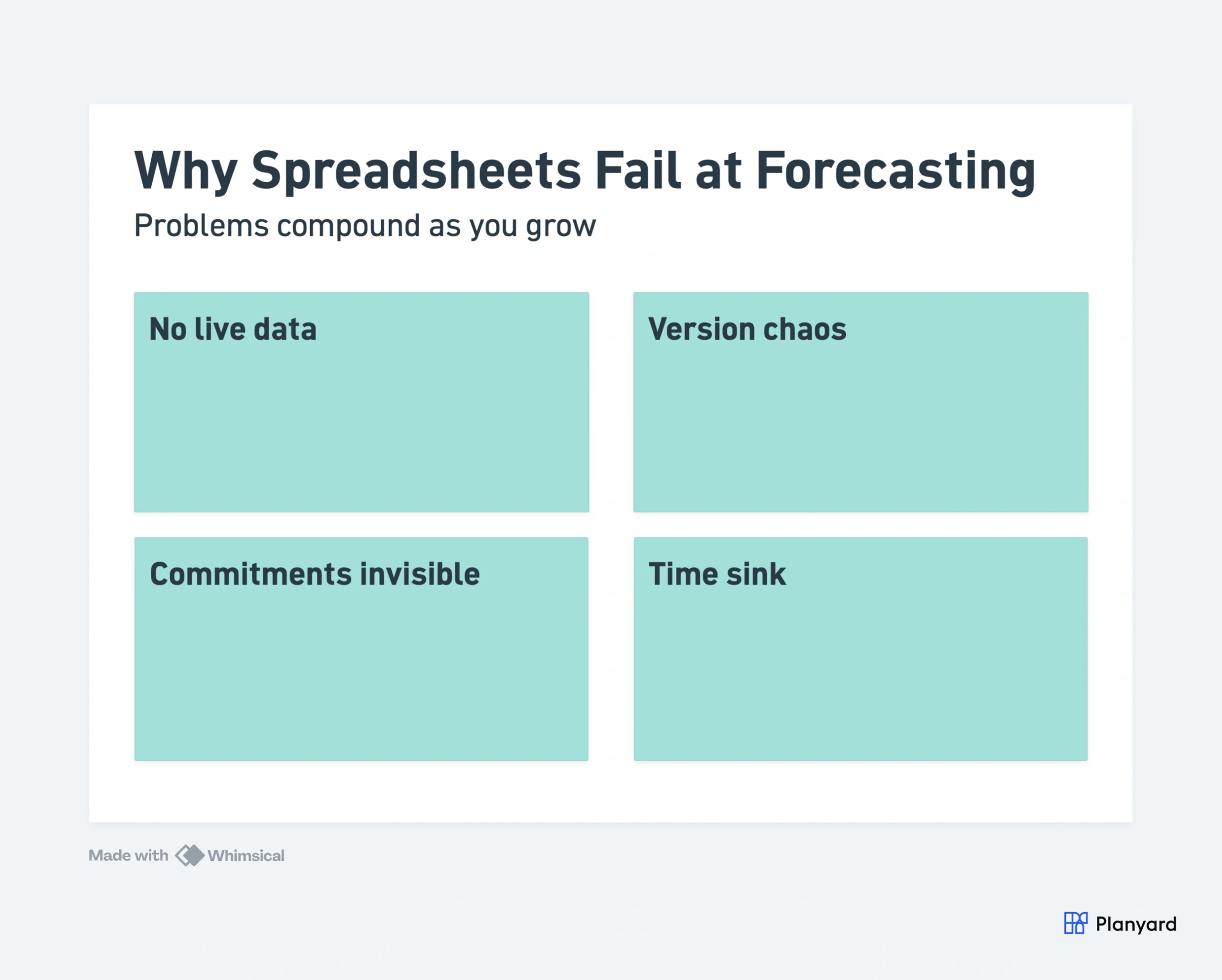
Most contractors start with spreadsheets. They work – until they don’t. The problems compound as you grow:
- No live data: the spreadsheet only knows what someone manually enters. Between updates, it’s fiction.
- Version chaos: multiple copies, no audit trail, no one knows which is current.
- Commitments invisible: spreadsheets don’t automatically connect POs and subcontracts to forecasts.
- Time sink: preparing a monthly forecast pack in Excel takes days – time better spent managing projects.
"In the past, I was only able to perform financial tracking once a month, and it would take me a couple of days just to gather the data I needed. For a single project alone, I’d spend at least two or three days just trying to understand its financial position. By the time I had the report ready, the data was already outdated."
Read more
The transition from spreadsheets to dedicated construction forecasting software typically happens when the pain of manual reporting exceeds the effort of changing tools. For most contractors, that’s somewhere between 5 and 15 live projects.
How Planyard handles construction forecasting
Planyard connects your budget, commitments, and actual costs in a single system. When you raise a PO or award a subcontract, the forecast updates automatically. When an invoice arrives and is matched to an order, the actual vs committed position updates in real time.
The result: your forecast is always current. No month-end compilation exercise. No chasing spreadsheets. Teams typically cut CVR preparation from days to minutes and get their first project live in one day.
"Planyard can save about 15 minutes per subcontractor payment. When I'm dealing with 50 subcontractors, that's 10 to 12 hours a month. Add the CVR reporting and all of a sudden I've got two extra days free."
Read more
See your project forecasts update in real time
No spreadsheets, no month-end data gathering. Start with a 14-day free trial.
Types of construction forecasting
Construction forecasting isn’t one thing – it covers several related disciplines:
- Cost forecasting: predicting the final cost of the project. The most common type, and what most people mean when they say “construction forecasting”. Read our full guide on forecasting project profitability.
- Cash flow forecasting: predicting when money comes in and goes out. Critical for managing working capital and avoiding cash crunches. See our guide to forecasting cash flow in construction.
- Cost-to-complete: estimating how much you still need to spend to finish the remaining work. The key input to your overall forecast. Learn more in our cost-to-complete guide.
Each serves a different purpose, but they all depend on the same underlying data: what you’ve committed, what you’ve spent, and what’s still to come.
Getting started with forecasting
You don’t need perfect data to start forecasting. You need a budget, a list of committed subcontracts and orders, and a realistic view of what’s still to procure. From there, the forecast builds itself as you work.
The key shift is moving from reactive cost reporting (looking backwards at what’s been spent) to proactive forecasting (looking forwards at where you’re heading). That shift – from “what did we spend?” to “what will we spend?” – is what separates contractors who control their margins from those who discover them at final account.
"Klaus can confirm that after the implementation of Planyard, there have been no projects where the financial results at the end of the project contained surprises."
Read more
Further reading
Comparing tools? See our guide to the best construction forecasting software for UK contractors.
- How to Forecast Construction Project Profitability
- Cost-to-Complete Forecasting in Construction: A Practical Guide
- Why Construction Forecasts Are Always Wrong (And How to Fix Them)
- Why Commitments Matter for Construction Forecasting
- Forecasting Cash Flow in Construction
- Construction Cost Value Reconciliation (CVRs) Explained
- How to Prepare a CVR in Construction
Forecast with committed costs, not stale invoices
Join contractors who know their margin position before month-end. Free 14-day trial.