
It’s month-end, and a QS is reviewing 45 trade headings on a £3M project, trying to answer one question per line: “How much more will this cost?” For committed packages it’s straightforward – the subcontract value is known. For the 12 uncommitted trades, it’s educated guesswork carried forward from last month with minimal challenge.
That exercise – estimating remaining costs to complete – is the single most important input to any construction forecast. This guide covers what cost-to-complete (ETC) means in practice, three methods for calculating it, a step-by-step monthly process, common mistakes, and how commitment tracking reduces the guesswork over time.
If you’re new to construction forecasting, start with the fundamentals.
What is cost-to-complete (ETC)?
Cost-to-complete is the remaining cost to finish all outstanding work on a project. In practical terms: “What do I still need to spend to get from where I am today to practical completion?”
It’s different from Estimate at Completion (EAC), which is the total forecast final cost:
EAC = Actuals to Date + ETC
Actuals are known – they’re invoices received, payments made. ETC is the variable. It’s where human judgement (and human bias) enters the forecast. And it’s what the monthly CVR review exists to challenge and refine.
In the context of UK construction, ETC is produced monthly as part of the cost value reconciliation cycle. The QS reviews each trade heading, assesses remaining cost exposure, and updates the forecast accordingly. Why ETC matters for profitability is covered in our profitability forecasting guide.
Why cost-to-complete matters
- It’s the forecast’s key input. Actuals are backward-looking. ETC is forward-looking. Your forecast accuracy depends almost entirely on ETC quality.
- It determines margin. If ETC is too low (optimistic), your forecast shows a healthier margin than reality. If ETC is too high (pessimistic), you may make unnecessary cost-cutting decisions.
- It’s where bias creeps in. Optimism bias, anchoring to last month’s figure, status quo bias – all manifest in how people estimate remaining costs.
- It drives decisions. A rising ETC signals the need to act: renegotiate, value-engineer, bring in additional resource, or communicate a problem to the client.
"We can spot the budget risks several months in advance and have a real-time forecast for end costs and profitability."

Three methods for estimating cost-to-complete
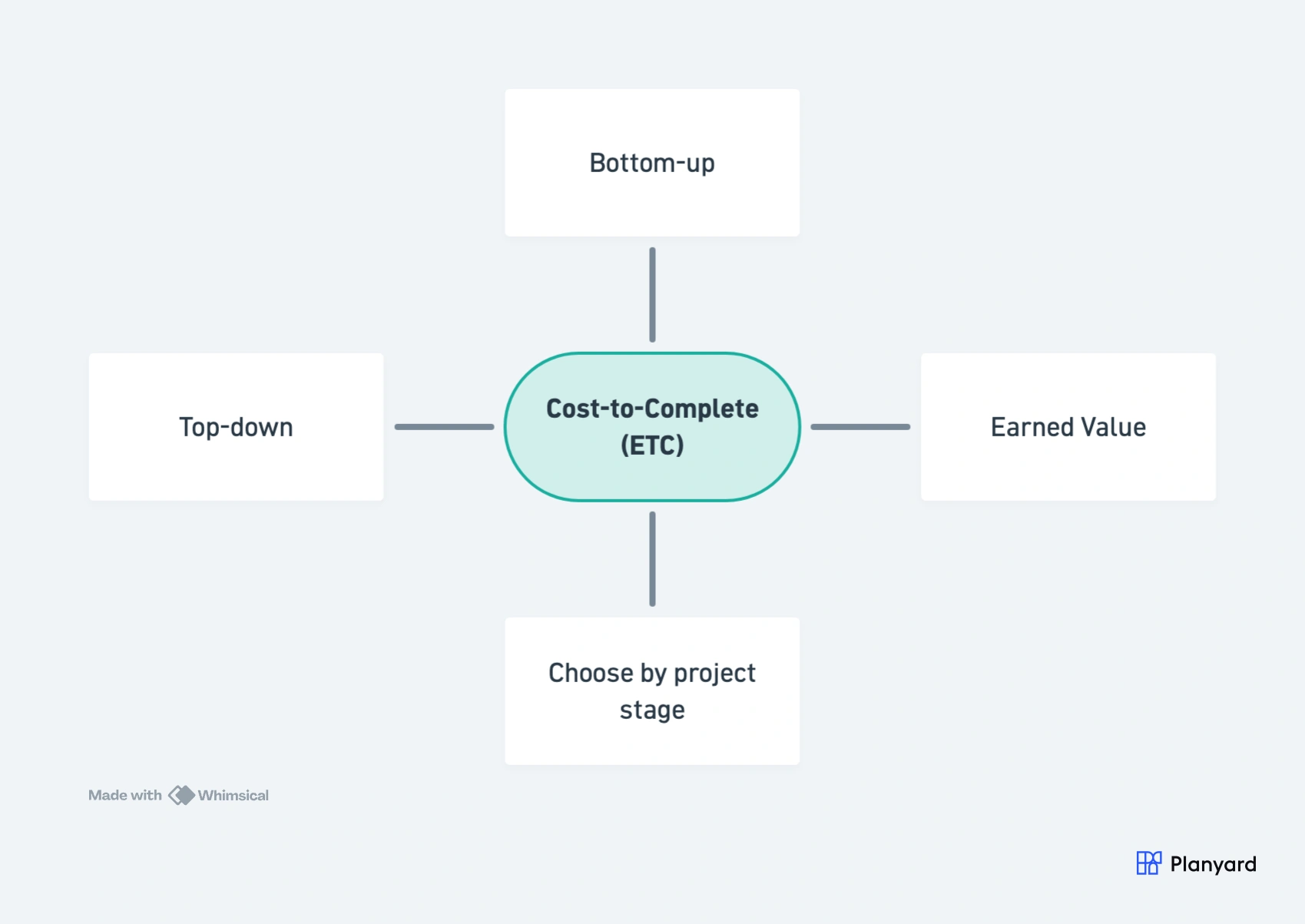
1. Bottom-up (trade-by-trade)
Go through each cost heading or trade package individually. For each one, assess:
- Committed amount (subcontract value, PO value)
- Amounts already certified / invoiced against that commitment
- Remaining commitment still to be invoiced
- Anticipated extras (variations to subcontracts, daywork, provisional sums to be expended)
- Uncommitted work still to procure (estimate remaining)
This is the most accurate method because it forces a line-by-line review. It’s also the most time-consuming – which is why it’s typically done monthly rather than weekly.
Best for: mid-project onwards when you have substantial commitment data. The more packages you’ve let, the more of the ETC is based on agreed prices rather than estimates.
2. Top-down (percentage complete)
Estimate the overall percentage complete of the project, then calculate:
ETC = (Budget × (1 – % complete)) + known variances
Quick to produce, but relies heavily on an accurate percentage-complete assessment. A 5% error in your percentage estimate can swing the ETC by hundreds of thousands on a large project.
Best for: early stage reviews, high-level portfolio reporting, or quick sense-checks between detailed reviews. Should never be your only method.
3. Earned value method
Uses performance to date to predict future performance:
ETC = (BAC – EV) / CPI
Where BAC = Budget at Completion, EV = Earned Value (budgeted cost of work performed), and CPI = Cost Performance Index (EV / actual cost).
Less common in UK construction QS practice – more prevalent on large infrastructure projects, NEC contracts with detailed project controls, or government frameworks. Requires rigorous earned value measurement, which many contractors don’t maintain at trade level.
Best for: large, complex projects with strong project controls infrastructure and dedicated planning teams.
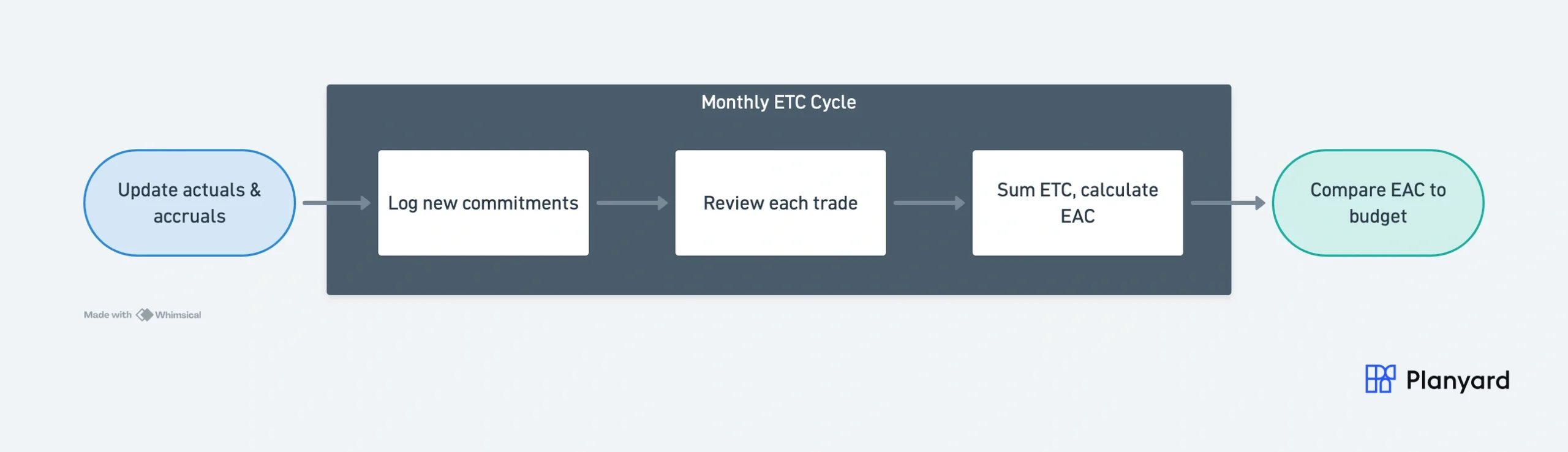
Step-by-step: monthly cost-to-complete process
Here’s the practical process most UK QSs and commercial managers follow monthly:
- Update actuals. Process all invoices received. Record accruals for work done but not yet invoiced.
- Update commitments. Log any new subcontracts awarded or POs raised since last review. Update existing commitments for variations or scope changes.
- Review each trade package. For committed packages: is the committed value still correct? Are there anticipated extras? For uncommitted work: re-estimate remaining based on current information.
- Assess risk and contingency. Has any contingency been consumed by crystallised risks? Are there new risks to allow for? Adjust remaining contingency accordingly.
- Sum to get total ETC. Remaining committed + remaining uncommitted + contingency = ETC.
- Calculate EAC. Actuals to date + ETC = Estimate at Completion.
- Compare EAC to budget. Is the project on track? Where are the variances? What action is needed?
"Planyard is a live overview of your projects. How they are performing financially and it is basically a CVR that is live all the time. It has up-to-date data."
Read more
Common cost-to-complete mistakes
These aren’t rare errors – they’re endemic in the industry. Recognise them in your own process and you’re halfway to fixing them.
| Mistake | What happens |
|---|---|
| Assuming committed = final | Final accounts almost always exceed the initial award. Variations, daywork, and provisional sums add up. Allow for extras in your ETC. |
| Not updating for known changes | A variation has been instructed but the ETC still reflects the original estimate. The “lazy forecast” – dangerously common. |
| Leaving contingency untouched | If a risk has crystallised, contingency should reduce and the cost line should increase. Carrying both double-counts the exposure. |
| Copy-pasting last month’s figures | Underlying assumptions go unchallenged for months. This is how £50K overruns hide in plain sight. |
| Not accounting for defects period costs | Retention release, defects remediation, final account disputes – real costs that many ETC exercises ignore. |
For more on why forecasts drift, read why construction forecasts are always wrong.
Automate committed cost tracking for better ETC
POs and subcontracts feed your forecast automatically. No manual data entry, no stale figures.
How commitments connect to cost-to-complete
The relationship between commitments and ETC is fundamental. Once you understand it, the entire forecasting process becomes clearer:
- Committed cost = baseline for that package’s forecast. The subcontract value is your starting point. Add anticipated extras to get the forecast for that trade.
- Uncommitted work = the area of uncertainty. These are the packages you haven’t let yet – you’re estimating based on budget allowances and current market pricing.
- As the project progresses, committed % increases. More packages are let → more of the ETC is based on real prices → less uncertainty → more reliable forecast.
- The commitment curve. Track committed percentage over time. A project that’s 70% committed has a far more reliable forecast than one that’s 30% committed.
This is why commitment tracking improves forecast accuracy. The more you’ve committed, the less you’re guessing.
"The main thing is that actually all the agreements we have made, all the orders, all the financial obligations taken on with this project, run directly into the system…"
Read more
Tools for cost-to-complete
The methodology doesn’t change with the tooling – but the effort and accuracy do.
Spreadsheets: the default for most UK contractors. Work at low project volumes. Problems emerge at scale: manual data entry, no live commitment feed, version control chaos, one person’s holiday creates a gap.
Dedicated software: connects committed costs (POs, subcontracts) directly to the forecast. When you award a subcontract, the committed value feeds the ETC for that trade automatically. Variances are highlighted. The QS spends time reviewing and deciding – not entering data.
Construction forecasting software eliminates the manual step of transferring commitment data into forecast spreadsheets. Teams get their first project live in under a day – no consultants, no format changes.
For contractors using Xero, Planyard integrates directly – giving you project-level ETC on top of your existing accounting without replacing it.
"We had to allocate several days each month in order to work with Excel. Now we're doing things on the fly – costs get processed when and where they occur."
Read more
Bringing it together
Cost-to-complete is the engine of your forecast. Get it right by:
- Using bottom-up reviews for monthly reporting (most accurate)
- Tracking commitments rigorously so the “known” portion of ETC grows over time
- Challenging last month’s figures rather than copy-pasting them
- Involving site teams who know what’s actually happening on the ground
- Comparing EAC to budget every month and investigating variances immediately
The goal isn’t perfect accuracy – it’s early visibility. A forecast that’s 5% off but flagged the problem in month 4 is infinitely more useful than a forecast that was “accurate” because nobody updated it until month 12.
Your ETC, updated automatically from committed costs
Stop copying last month's spreadsheet. Start forecasting from live commitment data.