
Your last 3 projects finished 5-8% over budget.
The board wants to know why. The usual answer – “unforeseen ground conditions” or “client changes” – does not cut it anymore. Most construction cost overruns are not caused by surprises. They are caused by slow information, late decisions, and invisible cost creep.
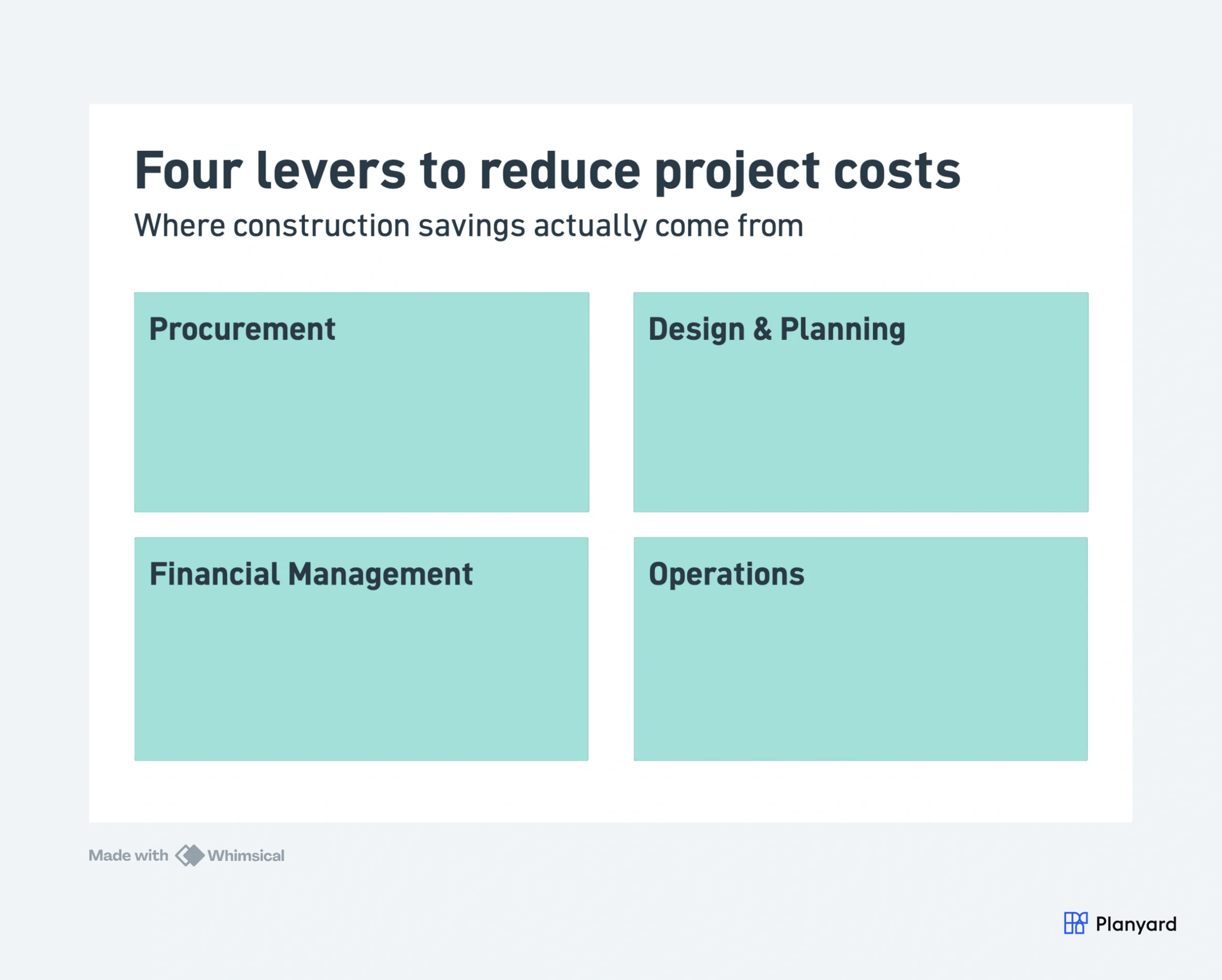
Here are 12 practical cost-reduction strategies for UK contractors – from procurement to technology – with real numbers on what each can save.
Why Construction Projects Go Over Budget
Industry data consistently shows 80-90% of construction projects exceed their original budget. The typical overrun on UK projects is 5-15% of contract value. For a 5 million GBP project, that is 250,000-750,000 GBP of margin erosion.
The root causes are predictable:
- Late cost visibility – monthly CVRs mean you discover overruns 4-6 weeks after they happen
- Scope creep – untracked variations and change orders accumulate silently
- Poor subcontractor management – payment disputes, unclear scope, late valuations
- Manual processes – spreadsheet errors, missed invoices, duplicate payments
The common thread: information arrives too late to act on it. Every strategy below addresses this by getting the right information to the right person faster.
Procurement and Subcontractor Strategies
1. Competitive tendering with more bidders
The simplest procurement saving: get more bids. Most small contractors tender packages to 2-3 subcontractors. Increasing to 4-6 creates genuine competition and typically generates a 5-15% spread between highest and lowest returns.
Digital RFQ tools make this manageable. Instead of emailing scope documents individually and tracking responses in spreadsheets, a tender management system sends packages to multiple subs simultaneously and compares returns side-by-side.
Typical saving: 5-15% on subcontract packages where you increase bidder count.
2. Early subcontractor engagement
Involving key subcontractors at preconstruction stage – before main contract award – reduces variations and rework during delivery. Subs who understand the design intent early can flag buildability issues, suggest cost-saving alternatives, and price more accurately.
In the UK, two-stage tendering is the formal mechanism for this. Even without a formal two-stage process, early conversations with your supply chain about upcoming packages improve pricing accuracy and reduce surprises.
Typical saving: 3-8% reduction in variations and re-work on packages with early engagement.
3. Better subcontractor payment management
Payment disputes with subcontractors are expensive. They consume commercial team time, damage relationships (meaning worse pricing next time), and can escalate to adjudication. Most disputes come from unclear scope, undocumented variations, or lost paperwork.
A proper subcontractor management system with a payment application portal eliminates most of this. Subs submit against a clear contract, variations are documented in real time, and both parties see the same numbers.
Typical saving: 2-5% of commercial team time recovered, plus fewer disputes = better rates from your supply chain.
"Everything has a PO linked to a job number. No one does a job without a purchase order, so when I look at margin I know it’s the true margin."
Read more
Design and Planning Strategies
4. Value engineering before construction starts
Challenge specifications that add cost without adding value. This is standard practice on large projects but often skipped by smaller contractors who accept designs as-is. Common savings: material substitutions (specified brand vs equivalent performance), simplified connection details, reduced overspecification of structural elements.
Typical saving: 5-10% of construction cost on applicable elements. Most effective on projects where the design team has not been cost-constrained.
5. Reduce rework through better documentation
Rework costs the UK construction industry an estimated 20 billion GBP annually. Much of it stems from ambiguous drawings, clashing services, or incomplete specifications. Every RFI represents a potential delay and cost.
Clear, coordinated documentation before work starts reduces RFIs, reduces rework, and reduces claims. This is a design team responsibility but the contractor can push for it during preconstruction.
Typical saving: Rework typically accounts for 5-10% of project costs. Even a 50% reduction in rework saves 2.5-5%.
6. Modular and off-site construction
Prefabrication reduces on-site labour, reduces waste, and compresses programme. Not applicable to every project, but bathroom pods, structural steel, precast concrete, and MEP modules can deliver significant savings on repetitive elements.
Typical saving: 10-20% on applicable elements versus traditional on-site construction. Most effective on residential and hotel projects with repetitive units.
Financial Management Strategies
7. Real-time cost tracking (not monthly)
Monthly CVRs (cost value reconciliations) are standard practice in UK construction. The problem: by the time you compile the CVR, review it, and act on it, the overrun happened 4-6 weeks ago. On fast-moving projects, that delay makes the difference between an intervention that saves money and a post-mortem that explains where it went.
Real-time cost tracking means you see committed costs (POs and subcontracts) and actual costs (invoices) updating continuously. When a package goes over budget, you know within days – not weeks.
Typical saving: Catching a 50,000 GBP overrun 4 weeks earlier on a 2M GBP project gives you time to re-tender, negotiate, or re-scope. Plus 3-4 days per month in reporting admin.
"For me to get my cost report on Planyard is four clicks of a button, and it's all in one screen – no more going to three different places and rebuilding everything in Excel."
Read more
8. Track committed costs, not just invoiced costs
This is the single biggest cost control improvement for SME contractors. Most companies only see costs when invoices arrive and get processed. But by the time an invoice lands, the money is already spent – you cannot negotiate or change course.
Committed costs are different. The moment you issue a purchase order or sign a subcontract, that cost is committed. A system that tracks committed costs gives you a forward-looking view: “Based on what we have already ordered, our projected final cost is X versus budget of Y.”
This is exactly what construction cost control software provides – and what spreadsheets typically fail at because they require manual updates that quickly fall out of date.
Typical saving: Difficult to quantify directly, but contractors report catching 3-5% of budget overruns earlier when they switch from invoice-based to committed-cost tracking.
9. Forecast-to-complete discipline
A budget is only useful if it is updated. Monthly forecast updates per cost code – comparing forecast final cost vs original budget – force your commercial team to actively think about where each package will land. Without this discipline, budgets become historical documents rather than management tools.
The key metric is “cost to complete” per cost code: what do we still need to spend to finish this element? Combined with committed costs and actuals, this gives you a reliable projected final cost for the whole project.
For a deeper guide on this process, see our article on construction forecasting.
Typical saving: Projects with monthly forecast discipline deliver 2-4% closer to budget than those without.
See your committed costs and projected margins in real time
Planyard tracks every PO and subcontract against your budget – so you know your projected final cost before the invoices arrive. 14-day free trial.
Operational Strategies
10. Reduce waste on site
Material waste typically accounts for 10-15% of material costs on UK construction sites. Better ordering (just-in-time delivery rather than bulk), proper material storage, and waste management plans can reduce this significantly.
WRAP (the Waste and Resources Action Programme) provides UK-specific guidance on construction waste reduction targets and methods. Most savings come from better planning rather than on-site sorting.
Typical saving: 3-5% of material costs through better ordering and storage practices.
11. Improve programme management
Every week of delay costs money in site overheads (preliminaries). On a typical UK project, weekly prelims run 5,000-20,000 GBP depending on site size. A 4-week delay therefore costs 20,000-80,000 GBP before any acceleration measures.
Better programme management – weekly progress tracking, early warning of delays, critical path monitoring – keeps projects on time and on budget. The link between programme and cost is direct and measurable.
Typical saving: Avoiding 2-4 weeks of prelims overrun saves 10,000-80,000 GBP per project.
12. Use technology to eliminate admin overhead
Manual processes are expensive in hidden ways. A QS manually processing invoices in spreadsheets spends 2-5 hours per week per project on data entry, cross-referencing, and error correction. Multiply across 5 projects and that is a full day per week – a quarter of their time – on admin instead of commercial management.
Automated invoice processing, digital purchase orders, and cloud-based approval workflows eliminate most of this. The QS spends their time on commercial decisions rather than data entry.
Typical saving: 1-2 days per week per QS recovered from admin. At a 70,000 GBP salary, that is 14,000-28,000 GBP of productive time per year per person.
"It easily saves half of a Quantity Surveyor’s time. When you're looking at a £70,000 annual salary, that level of cost-effectiveness makes the decision to implement the system very simple."
Read more
"Timewise, on a single project, I'd probably save 6 to 8 hours—essentially a full day every month. When it comes to processing monthly payments, it saves me a solid day, perhaps even a day and a half, just in sorting through the invoices. Saving a day and a half of my time means the system pays for itself time and time again."
Read more
How Much Can You Actually Save?
| Strategy | Typical Saving | Effort to Implement |
| 1. More bidders per package | 5-15% on sub packages | Low (process change) |
| 2. Early sub engagement | 3-8% variation reduction | Medium (preconstruction time) |
| 3. Better payment management | 2-5% team time recovered | Medium (needs system) |
| 4. Value engineering | 5-10% on applicable elements | Medium (design stage) |
| 5. Reduce rework | 2.5-5% of project cost | High (design team coordination) |
| 6. Off-site construction | 10-20% on repetitive elements | High (design and procurement) |
| 7. Real-time cost tracking | Earlier interventions + 3-4 days/mo saved | Low (software) |
| 8. Committed cost tracking | 3-5% earlier overrun detection | Low (software) |
| 9. Forecast-to-complete | 2-4% closer to budget | Medium (monthly discipline) |
| 10. Reduce site waste | 3-5% of material costs | Medium (process change) |
| 11. Programme management | 10,000-80,000 GBP per project | Medium (weekly discipline) |
| 12. Automate admin | 14,000-28,000 GBP per QS per year | Low (software) |
Tools That Help Reduce Construction Costs
Technology is not the only answer – but it enables most of the strategies above. Here are the categories of tools that support construction cost reduction:
- Cost tracking and job costing: Planyard, Procore, LiveCosts – real-time budget vs actual per project
- Procurement and tendering: Planyard (RFQs and bid comparison), Procore – competitive tendering at scale
- Accounting integration: Xero + Planyard, Sage – synced data without double entry
- Programme management: MS Project, Asta Powerproject – critical path and resource management
- Estimating: Buildxact, Planyard – accurate pricing at tender stage
For a full comparison of cost control tools, see our guide to the 7 best construction cost control software options.
Stop finding overruns at month-end
Planyard shows you committed costs and projected margins in real time – on top of Xero or QuickBooks. 14-day free trial, no credit card required.