
You are running three projects. Your bookkeeper enters subcontractor invoices into Xero every Friday, but you cannot see which job is profitable until month-end.
Last verified: October 2026
CIS returns are manual. Retention is tracked in a spreadsheet tab you have not updated since April. And when your director asks “are we making money on the Greenfield job?” – you genuinely do not know.
This guide ranks 8 accounting software options for UK builders and contractors – from Xero add-ons to full construction platforms – with real costs, CIS features, and integration details. It also looks at how far Xero or QuickBooks can take you on their own, then profiles 7 tools built mainly for the US and Canadian market that turn up in the same searches.
What Makes Construction Accounting Different?
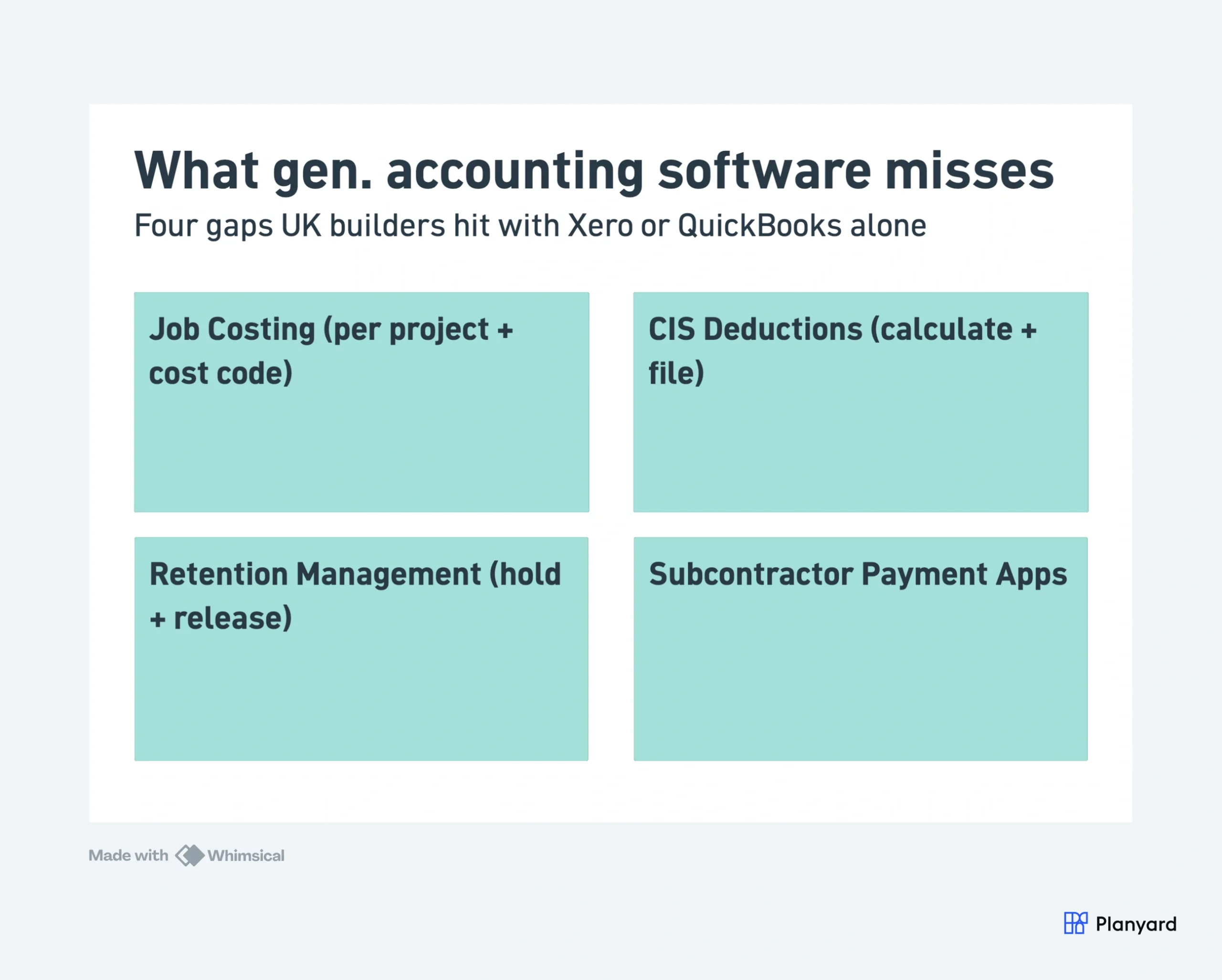
Standard accounting software tracks company-wide income and expenses. Construction accounting needs to go further – breaking everything down by project, package, and cost code. Here is what general tools miss:
- Job costing per project – tracking costs against budget at project level, not just company-wide P&L
- CIS deductions and returns – calculating and reporting Construction Industry Scheme deductions to HMRC
- Retention management – holding and releasing retention amounts across defects periods
- Subcontractor payment applications – receiving, checking, and approving monthly valuations from subcontractors
- Interim valuations – stage payments and applications for payment to clients
- Multiple cost codes per project – separating labour, materials, plant, and preliminaries within each job
If your business does any of the above, a general accounting tool alone will leave you with blind spots. The question is whether you need a standalone construction platform or an add-on that works with your existing accounting software.
"When I have been working on cloud accounting like Xero and Quickbooks they don’t have a specific construction-based costing tool. You have project management costing tools but they are not aimed at the level of what construction companies need so I came across Planyard and I was like finally there is something that solves the problem."

Can Xero or QuickBooks Do the Job on Their Own?
Most builders start with a general accounting tool, and for good reason. Xero and QuickBooks are cheap, your accountant already knows them, and both connect to a long list of other platforms. For construction accounting, the question is how far you can push them before the workarounds cost more than a dedicated tool would.
Where General Tools Hold Up
The usual workaround is to add a handful of construction-specific accounts to your chart of accounts, or a small subset of cost accounts for each project. The other route is a unique account for every job on every project, and that adds so much complexity that few firms keep it up. With a few live projects and a bookkeeper who talks to the site team, the lighter version is enough to see roughly what each job cost.
Where They Break Down
The first problem is coordination. Your bookkeeper has to check with project management on every invoice to confirm which account it belongs to and whether that subcontractor has already been paid for the work. That conversation happens weekly at best, so the ledger always lags the site.
The second is that accounting software records what has already happened. It does not hold your estimate, your forecast, or the progress claims still to come, so project managers end up keeping those in a separate spreadsheet anyway. Committed costs from purchase orders and subcontracts do not appear until the invoice lands.
That delay is the real cost. If the ledger is your only source of truth, you find out a job lost money after it is finished. Companies have gone under with healthy-looking books because nobody could see the forecast.
Before Any Software: Spreadsheets and Email
For a sole trader with a few subcontractors and a handful of invoices a month, a spreadsheet budget and an email inbox are manageable and the risk of mistakes is low. An unread email is a cost still to be dealt with, a read one has probably been entered. If that is where you are, our free construction budget template and cost code structure give you a workable setup until the volume outgrows it.
How We Evaluated These Tools
We assessed each platform against the specific needs of UK builders and contractors running 1-50 projects per year:
- CIS compliance – does it calculate deductions and file returns, or do you still need a workaround?
- Job costing depth – can you track costs per project, per package, and per cost code?
- Integration with Xero, QuickBooks, or Sage – does it sync automatically or require manual export?
- Pricing for small contractors – what does it actually cost for a team of 1-20 users?
- UK support and setup – can you get started without a 6-month implementation project?
The 8 Best Accounting Software Options for UK Builders
1. Planyard – Best for Job Costing with Xero or QuickBooks Integration
Planyard is a construction-specific cost management platform that sits on top of your existing accounting software. It handles job costing, subcontractor payment applications, purchase orders, and budget tracking – then syncs everything to Xero, QuickBooks, or Sage automatically.
For UK builders already using Xero or QuickBooks but struggling with per-project visibility, Planyard fills the gap without replacing anything. Subcontractors submit their own payment applications through a portal, invoices are matched to purchase orders, and CIS deductions are applied before syncing to your accounting ledger.
Best for: Small-to-mid UK contractors (5-50 staff) already on Xero or QuickBooks who need construction-specific job costing without a full ERP.
Key features:
- Per-project job costing with multiple cost codes
- Subcontractor payment application portal
- Automated 3-way matching (PO, contract, invoice)
- Two-way sync with Xero, QuickBooks, and Sage
- Real-time budget vs actual dashboards
- CIS deduction management
- Purchase orders that add committed cost to the budget the moment they are issued
- Invoice capture through an accounts payable email address, with PO reference matching and approval flows
- RFQs with side-by-side bid comparison, plus client contracts, variations, and CVR
Pricing: From 79 GBP per month. 14-day free trial, no credit card required.
Pros: Fast setup (live in under a day), no replacement of existing accounting, subcontractor portal reduces admin, real-time project margins.
Cons: Not a full accounting package – you still need Xero, QuickBooks, or Sage for general ledger, payroll, and VAT returns. It also does not cover scheduling, field management, or CRM.
"We had to get our accountant on board and interface it with Xero, so invoices hit the right job number. Now an invoice gets uploaded in Planyard, I sign it off, and it drops into my Xero payment schedule in three or four weeks – it’s perfect."
Read more
2. Xero – Best General Accounting for Sole Traders and Small Builders
Xero is the most popular cloud accounting platform for UK small businesses. It handles invoicing, bank reconciliation, VAT returns, and basic reporting. Most UK accountants work with Xero, which makes collaboration straightforward.
For sole traders or very small builders running 1-2 jobs at a time, Xero on its own may be sufficient. You can use tracking categories for basic project allocation. But once you hit 3+ active projects or start managing subcontractor packages, the limitations become clear.
Best for: Sole traders and small builders (1-5 staff) with simple project structures who primarily need bookkeeping and VAT compliance.
Key features:
- Bank feeds and automated reconciliation
- Invoicing and payment tracking
- VAT returns filed to HMRC (MTD compliant)
- Tracking categories for basic project allocation
- Large app marketplace for add-ons
Pricing: From 15 GBP per month (Starter) to 42 GBP per month (Premium).
Pros: Affordable, widely supported by UK accountants, excellent bank feeds, large ecosystem of add-ons.
Cons: No per-project job costing, no subcontractor payment workflows, no retention tracking, CIS requires a separate add-on or manual processing.
3. Sage 50 – Best for Established Contractors Needing CIS
Sage 50 has been the default accounting software for UK construction companies for decades. It handles CIS natively, supports detailed nominal coding for project allocation, and integrates with Sage Payroll for PAYE and pension management.
If your business has used Sage for years and your accountant knows it inside out, switching may not be necessary. Sage 50 handles CIS deductions, subcontractor statements, and HMRC returns without add-ons. The trade-off is that it is desktop-based (with cloud add-ons), the interface feels dated, and proper job costing requires disciplined nominal code setup.
Best for: Established UK contractors (10-50 staff) with an in-house accounts team already trained on Sage who need native CIS compliance.
Key features:
- Native CIS deductions and HMRC returns
- Detailed nominal coding for project allocation
- Integration with Sage Payroll
- Purchase ledger with batch invoicing
- Bank reconciliation and VAT MTD
Pricing: From 30 GBP per month. Annual contracts typical.
Pros: Native CIS, UK payroll integration, most accountants familiar with it, reliable for compliance.
Cons: Desktop-first architecture, dated interface, limited real-time project visibility, job costing requires manual setup and discipline.
4. QuickBooks Online – Best for Contractors Already Using QBO
QuickBooks Online is a strong general accounting platform with growing adoption in UK construction. It offers better project tracking than Xero out of the box, with a dedicated Projects feature that lets you assign income and expenses to jobs.
For contractors already on QuickBooks, it makes sense to stay and add a construction layer on top rather than migrating. QuickBooks handles VAT, bank feeds, and basic job costing. For deeper construction features like subcontractor payment apps and proper cost code structures, pair it with a tool like Planyard.
Best for: Small UK contractors (1-20 staff) already using QuickBooks who want to stay on the platform and add construction features incrementally.
Key features:
- Built-in Projects feature for job-level tracking
- Bank feeds and VAT MTD compliance
- Invoicing with project allocation
- Receipt capture via mobile app
- Integration with construction-specific add-ons
Pricing: From 12 GBP per month (Simple Start) to 35 GBP per month (Advanced).
Pros: Better native project tracking than Xero, affordable, mobile app, growing UK adoption.
Cons: CIS not native (requires add-on), project tracking limited to single-level allocation, no subcontractor portal, no retention management.
5. FreeAgent – Best for CIS-Registered Subcontractors
FreeAgent is designed for freelancers and small businesses in the UK. It handles CIS for subcontractors natively – meaning if you are a subcontractor being deducted from, FreeAgent tracks your CIS deductions and helps you reclaim them. It also handles self-assessment, VAT, and basic invoicing.
FreeAgent is not designed for main contractors managing multiple subcontractors. It is best suited for individual tradespeople or small specialist subcontractors who need to track their own CIS deductions and file their own returns.
Best for: CIS-registered subcontractors and sole trader tradespeople who need to manage their own tax affairs and reclaim CIS deductions.
Key features:
- CIS deduction tracking and reclaim
- Self-assessment tax estimates
- Invoicing with automatic payment reminders
- Bank feeds and VAT MTD
- Free with NatWest, RBS, and Mettle business accounts
Pricing: From 14.50 GBP per month. Free with selected UK business bank accounts.
Pros: Excellent CIS handling for subcontractors, self-assessment integration, potentially free with your bank account, simple interface.
Cons: Not designed for main contractors, no job costing across multiple projects, no subcontractor management features, limited to sole traders and micro businesses.
See your project costs in real time – without replacing Xero
Planyard connects to your existing accounting software. Set up your first project in under an hour. No credit card required.
6. Procore (Financial Management Module) – Best for Large Contractors
Procore is a project management platform for large construction companies. Its Financial Management module adds budgeting, commitments tracking, payment applications, and change order management on top of Procore’s core project and document management features.
Procore is designed for main contractors running projects above 5 million GBP with large teams and multiple project managers. It is overkill for small-to-mid UK builders, both in complexity and cost. But for organisations managing 20+ concurrent projects with dedicated commercial teams, it provides comprehensive financial oversight.
Best for: Large UK main contractors (50+ staff) running complex, high-value projects who need integrated project management and financial control.
Key features:
- Budget management with change order tracking
- Commitment and payment application workflows
- Integration with Sage, Xero, and other ERPs via connectors
- Document management and project coordination
- RFIs, submittals, and drawing management
Pricing: Custom pricing. Typically 1,000+ GBP per month. Annual contracts with implementation fees.
Pros: Comprehensive project management, strong document control, widely used on large UK projects, good API ecosystem.
Cons: Expensive, long implementation timeline, overkill for small contractors, financial module is add-on (not included in base), limited native CIS support.
One more thing to check before you request a quote: Procore’s pricing includes a revenue-based component, which makes the final figure hard to predict from a seat count. We have written separately about the complexity of the Financials module and what Procore costs.
7. The Access Group (COINS) – Best for Mid-to-Large Main Contractors
The Access Group acquired COINS and now offers a construction-specific ERP covering accounting, project management, procurement, and subcontractor management. It is one of the few platforms built specifically for UK construction from the ground up, with native CIS, retention, and certificate management.
Access Construction (formerly COINS) is designed for main contractors with dedicated commercial and finance teams. It handles the full financial lifecycle from tender through to final account. The trade-off is implementation complexity and cost – expect a 3-6 month rollout and dedicated project management.
Best for: Mid-to-large UK main contractors (20-500+ staff) who need a single platform for accounting, project management, and subcontractor management with native CIS.
Key features:
- Full construction ERP with native CIS and retention
- Subcontractor management and payment certificates
- Procurement and supply chain management
- Contract and commercial management
- Cloud deployment with mobile access
Pricing: Custom pricing. Typically 500-2,000+ GBP per month depending on modules and users. Implementation fees apply.
Pros: Built for UK construction, native CIS and retention, comprehensive subcontractor management, scales to large organisations.
Cons: Expensive, 3-6 month implementation, complex interface, overkill for contractors under 20 staff, requires dedicated admin resource.
8. Buildertrend – Best for Residential Builders
Buildertrend targets residential builders and remodellers. It combines project management, client communication, estimating, and basic financial tracking in one platform. Its strength is the client-facing portal where homeowners can view progress, approve selections, and make payments.
For UK residential builders managing extensions, new builds, and renovations, Buildertrend handles the full client lifecycle from estimate to completion. The financial features are lighter than dedicated accounting tools – you will still need Xero or QuickBooks for your actual bookkeeping.
Best for: Residential builders and remodellers (1-20 staff) who want project management, client communication, and basic financials in one tool.
Key features:
- Client portal with progress updates and selections
- Estimating and proposal generation
- Scheduling and task management
- Basic budget tracking and invoicing
- Integration with Xero and QuickBooks
Pricing: From 99 USD per month (approximately 80 GBP). Annual discount available.
Pros: Excellent client communication tools, good for residential workflow, estimating features, all-in-one for small builders.
Cons: US-focused (limited UK localisation), no native CIS, financial features are basic, still needs separate accounting software, priced in USD.
Comparison Table
| Software | CIS | Job Costing | Retention | Xero Sync | Best For | From (GBP/mo) |
| Planyard | Via Xero/Sage | Per project + cost code | Yes | Two-way | SME contractors on Xero/QBO | 79 |
| Xero | Add-on only | Tracking categories | No | N/A (is Xero) | Sole traders | 15 |
| Sage 50 | Native | Nominal codes | Manual | No | Established contractors | 30 |
| QuickBooks | Add-on only | Projects feature | No | No (is QBO) | Small contractors on QBO | 12 |
| FreeAgent | Subcontractor CIS | No | No | No | CIS subcontractors | 14.50 |
| Procore | Limited | Budget-level | Yes | Via connector | Large contractors (50+) | 1,000+ |
| Access Group | Native | Full ERP | Yes | No | Mid-large contractors (20+) | 500+ |
| Buildertrend | No | Basic | No | Yes | Residential builders | 80 |
Options Outside the UK
The tools below come up in the same searches but are built mainly for the North American market. We have not scored them against the UK criteria above, so treat these as short profiles rather than recommendations.
Sage 300 Construction and Real Estate
Sage 300 Construction and Real Estate is a different product from the Sage 50 covered above. It is Sage’s package for construction companies and property developers, built around budgeting, tracking cost against budget, and adjusting forecasts as the job moves. Change orders and subcontractor contracts are managed inside it.
Cost breakdowns are user-defined, so you set up your own structure for tracking and reporting. It also connects field operations with the back office, adds cloud and mobile access, and includes document control for a clean audit trail.
Best for: Contractors and property developers who want Sage’s construction-specific product and have outgrown nominal code workarounds in Sage 50.
JOBPOWER
JOBPOWER tracks costs against budget in real time, broken down by project phase. Payroll, purchase orders, and document management are built in, which covers both material costs and subcontracted labour.
Reporting includes job cost reports, profit and loss statements, and budget comparisons, all customisable. Vendor and subcontractor payments feed straight into job costs.
Best for: Contractors who want payroll and job costing in one system.
eSUB
eSUB is a cloud platform for electrical, mechanical, drywall, HVAC, plumbing, and other speciality subcontractors. The office works in the browser and site teams use a mobile app, with the aim of closing the gap between the two.
It tracks labour, material costs, and project budgets in real time and can be set up to match your own systems, phases, and cost codes. Historical project data feeds into estimates and helps identify which jobs made money.
Best for: Trade subcontractors who want field and office on one system.
Plexxis
Plexxis also targets subcontractors and speciality trades. It tracks labour, materials, equipment, and subcontractor costs in real time so budget variances show up early enough to act on.
Estimating and bid preparation sit in the same platform as job costing, change order management updates the budget automatically, and timekeeping and workforce management feed labour costs through to the job cost reports.
Best for: Speciality trade contractors who want estimating, timekeeping, and job costing together.
CoConstruct
CoConstruct is project management and financial software for custom home builders and remodelers. It tracks expenses against budget per project in real time, manages change orders with automatic budget updates, and includes time tracking so labour hours show up in job costs. Materials are followed from estimate to actual.
Reviewers like having client and subcontractor communication and all project documents in one place. The common complaints are an interface that could use a refresh, sluggishness, and navigation that takes some learning. Commercial contractors running several concurrent projects with subcontractors tend to find it too shallow for project-level cost control.
Best for: Renovators and remodelers who also use subcontractors for parts of the work.
Knowify
Knowify is a cloud tool for residential contractors and smaller subcontractors. It is aimed at firms that do little subcontracting themselves, so budget management with subcontractors involved is where it is thinnest.
Reviews single out ease of use, the bidding tools, and invoicing as its strengths. The downsides mentioned are UX issues and small bugs, which reviewers say get fixed quickly, and some users report that their own customers complain about the invoices.
Best for: Subcontractors who do not subcontract work out themselves.
Builder Prime
Builder Prime is built for residential trade contractors in roofing, siding, solar, and painting who want CRM and estimating in one tool. Its automation is strongest in lead tracking and scheduling, and project-level cost control is a secondary concern.
Best for: Residential trade contractors whose main gap is sales and scheduling.
"It easily saves half of a Quantity Surveyor’s time. When you're looking at a £70,000 annual salary, that level of cost-effectiveness makes the decision to implement the system very simple."
Read more
How to Choose the Right Option
The right accounting software depends on three factors: your company size, your current accounting setup, and your project complexity.
By Company Size
Sole trader or 1-3 staff: Start with Xero or FreeAgent for bookkeeping and CIS. Add a construction layer later when project volume grows.
5-20 staff, already on Xero or QuickBooks: Add Planyard on top for job costing, subcontractor management, and real-time project margins. Keep your accountant on Xero – everything syncs.
20-50+ staff: Evaluate Sage 50 (if you need to own the accounting), Access Group (if you want a full construction ERP), or Planyard (if you want the speed of a modern tool without a 6-month implementation).
By Current Accounting Setup
Already on Xero: Stay on Xero for your general ledger. Add Planyard for construction-specific job costing. Two-way sync means your accountant sees everything in Xero without changing their workflow.
Already on Sage: If Sage 50 meets your needs and your team knows it, stay. If you want better project visibility without migrating, Planyard also integrates with Sage.
No accounting software yet: Start with Xero (most UK accountants prefer it) and add Planyard when you need per-project tracking.
By Project Complexity
Single trade, simple jobs: Xero or QuickBooks alone. You do not need construction-specific software for straightforward work without subcontractor packages.
Multi-package main contractor: You need proper job costing with cost codes, subcontractor payment management, and retention tracking. Planyard, Sage 50, or Access Group depending on your size.
Large, complex projects (5M+ GBP): Procore or Access Group for full project and financial management. Budget for implementation time and dedicated admin.
Features to Check in a Demo
Whichever tier you land in, the same handful of capabilities separate tools that give you a live picture from tools that record history. Ask to see each one with your own project data.
- Committed costs captured when a purchase order or subcontract is issued, so the forecast moves before the invoice arrives
- Purchase orders and subcontracts linked to budget lines, with approvals in the same workflow
- Variation tracking, since almost every subcontract gets adjusted before it closes
- Budget and cost-to-complete analysis, so you know whether the job will finish in profit and when you might need extra cash
- Invoice collection and approval matched against the purchase order
- Live reporting across all projects of budget against committed against actual, without waiting for month-end
- Access from any device, which in practice means a cloud tool and no server to look after
Practical Steps Before You Sign
Start by writing down your actual problems, in your own words. “We need to see committed costs before invoices arrive” is a requirement. “Better reporting” is a wish. The pain points we hear most often are budgets that drift because commitments are invisible until invoiced, RFQs and purchase orders run through email, the same figures keyed into a spreadsheet, the accounts package, and a report, and a month-end reconciliation between project data and company accounts that nobody enjoys.
Then ask for a trial with your own project data rather than a canned demo, and put your project managers, quantity surveyors, and accounts staff in the room. If the QS and the PM will not use it, the feature list is irrelevant.
Two questions cut through most sales conversations. How long until my team is productive, in hours or in months? And what does it cost in total once you add seats, integrations, and training time? Check as well whether the tool scales from 3 projects to 30 and whether the pricing is published. A low seat price with a six-month rollout is often the expensive option.
"Planyard is exactly what I’m after as a business owner: a good-value system that keeps everything in one place, saves me money and makes sure I’m not losing any money on projects. As a businessman, that’s a no-brainer."
Read more
FAQ
What is the best accounting software for a small construction company in the UK?
For small UK contractors running 1-10 projects, Planyard paired with Xero gives you construction-specific job costing without replacing your existing accounting setup. Sole traders with simple books may find Xero or FreeAgent sufficient on their own. The right choice depends on whether you need per-project cost tracking or just company-wide bookkeeping.
Do builders need construction-specific accounting software?
If you track costs per project, manage subcontractor payments, or handle CIS deductions, yes. General tools like Xero handle invoicing and bank feeds well but cannot allocate costs to individual jobs or automate CIS returns. A construction layer on top fills that gap without replacing your accountant’s preferred platform.
Can I use Xero for construction job costing?
Xero alone does not support per-project job costing at the level builders need. You can use tracking categories for basic allocation, but it breaks down with multiple cost codes, subcontractor packages, and retention. Pairing Xero with a construction-specific tool like Planyard gives you proper job costing while keeping Xero as your accounting ledger.
What accounting software handles CIS automatically?
Sage 50 and FreeAgent both handle CIS returns natively within the UK. Planyard integrates with Xero to manage subcontractor payments with CIS deductions applied before syncing to your accounting platform. The key is choosing software that calculates deductions at payment stage rather than requiring manual adjustments afterwards.
How much does construction accounting software cost in the UK?
Standalone tools like Xero start at around 15 GBP per month. Construction-specific platforms like Planyard typically range from 50 to 300 GBP per month depending on project volume. Enterprise systems like Procore or The Access Group often cost 1,000 GBP per month and above, with implementation fees on top.
What is the difference between construction accounting software and a general accounting tool?
General accounting tools manage company-wide profit and loss, bank feeds, and VAT returns. Construction accounting software adds per-project job costing, subcontractor payment applications, retention tracking, and cost-to-complete forecasting. The distinction matters because a profitable company can still have loss-making projects hidden inside the overall figures.
Can accounting software track costs per project?
Construction-specific tools like Planyard, Sage 50, and The Access Group all track costs per project with multiple cost codes. General tools like Xero require workarounds using tracking categories, which become unmanageable beyond 3-5 active projects. If per-project visibility is a priority, choose a tool built for it.
How long does it take to implement construction accounting software?
It depends on the tier. Enterprise platforms like Procore or The Access Group take weeks or months, with a 3-6 month rollout typical for a full construction ERP. Tools built for smaller contractors, like Planyard, usually have a team working within hours: you import your existing budget structure and start tracking against it the same day.
Stop waiting until month-end to know your margins
Planyard gives you real-time project costs on top of Xero or QuickBooks. 14-day free trial, no credit card, live in under a day.