
It’s final account day on a £2.5M fit-out. The forecast said 7% margin throughout. The outturn says 3%. The director asks what happened. The QS can point to five separate cost movements – but none of them appeared in the forecast until it was too late to act.
This isn’t a “tips for better forecasting” article. It’s a diagnosis of the six structural reasons construction forecasts drift – from stale data and commitment gaps to copy-paste syndrome and variation limbo. Each reason comes with a specific fix. The pattern: fix the system, not the people.
For the fundamentals of construction forecasting, see What Is Construction Forecasting.
The uncomfortable truth
Most construction forecasts are wrong. Not by a little – by enough to turn a profitable project into a loss-maker. Industry data consistently shows that fewer than a third of projects finish within 10% of their original budget. And the forecast – which should be catching this drift early – often misses it until the final account.
Why? Not because QSs are bad at their jobs. Because the systems, processes, and data they’re working with have structural flaws that make accuracy nearly impossible. Here are the six biggest ones.
"With our old system, all the data we were looking at were yesterday's numbers. Construction works on very tight margins – costs can run away with you quickly. By the time we'd navigated the software and got a report out of it, we could find that our project was making a loss, and it was too late."
Read more
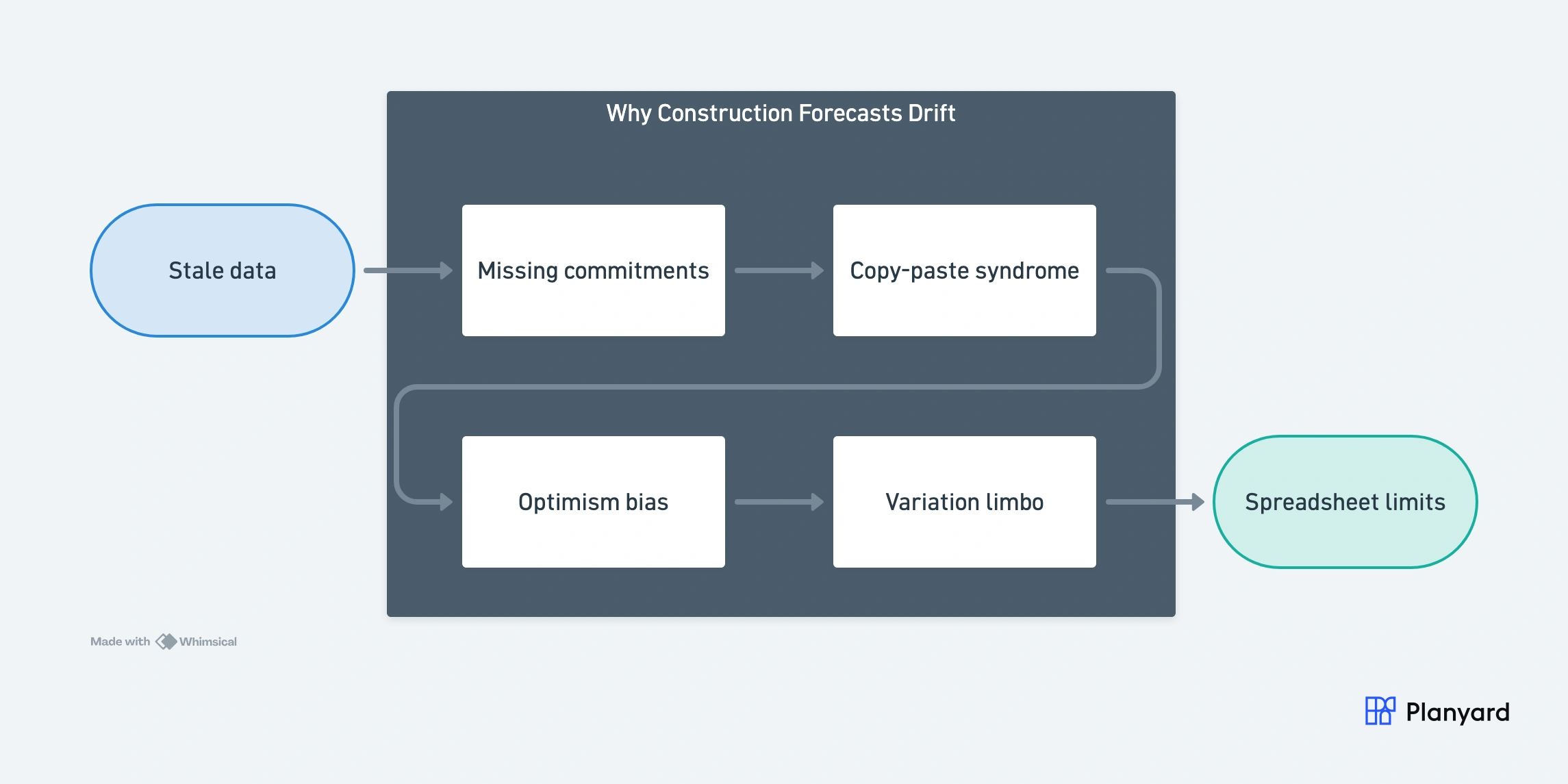
Reason 1: The data is already stale
You produce a forecast on the 1st of the month. It’s based on invoices received up to the 28th of last month. But those invoices cover work done 2-4 weeks before that. So your “current” forecast reflects the cost position from 6-8 weeks ago.
In those 6-8 weeks, three subcontractors started work, a variation was instructed, and material prices moved. None of it appears in your forecast because none of it has been invoiced yet.
By the time a cost overrun appears in invoice-based reporting, it happened a month ago. You’ve lost a month of reaction time.
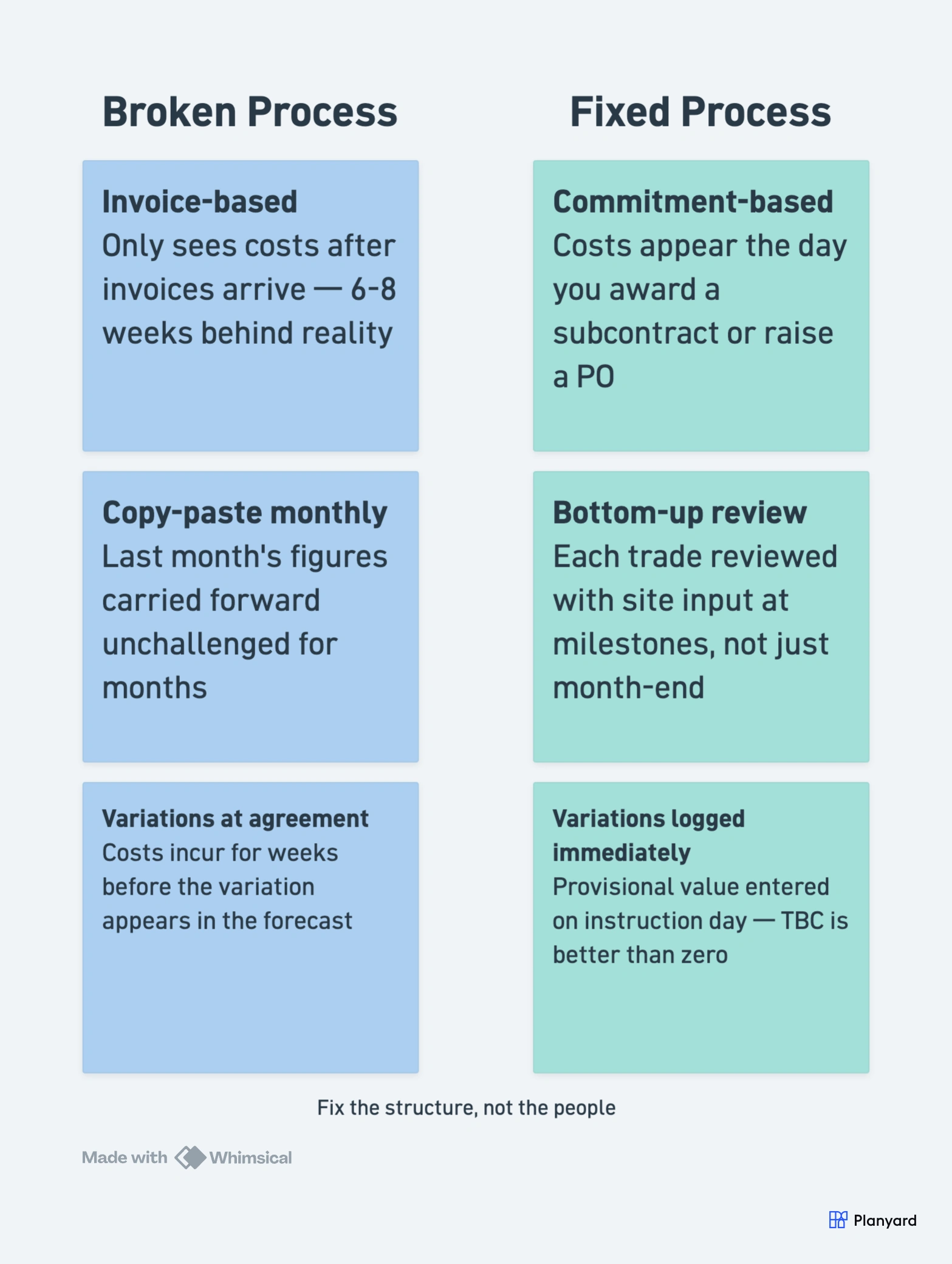
The fix: track commitments and accruals, not just invoices. The moment you let a subcontract, the cost appears in your forecast – not when the first invoice arrives weeks later. Read more about how timing mismatches affect cash flow forecasting.
Reason 2: Committed costs aren’t in the forecast
This is the single biggest source of forecast error in construction – and the least discussed.
You’ve let a subcontract for £200K. It’s signed. The subcontractor will invoice you. But your cost report – which shows “costs to date” – shows £0 against that trade because no invoice has arrived yet. Your forecast, built from that cost report, doesn’t reflect the £200K obligation.
Multiply this across every package on the project. You might have £500K in committed obligations that don’t appear anywhere in your forecast. That’s not a small error – it’s a structural blind spot.
The fix: include all committed costs in the forecast from the day of award. If you’ve signed a subcontract, it belongs in your cost position immediately – not when the first invoice arrives. This is explored in depth in why commitments matter for forecasting.
"There is no delay in synchronization – which means that the problems get visualized when they happen and not one month later."
Read more
Reason 3: Copy-paste syndrome
It’s month-end. The QS opens last month’s forecast. Tweaks one or two lines – the package that was let last week, the invoice that came in higher than expected. Saves it. Sends it to the director. Done.
The problem: the other 40 lines weren’t reviewed. The assumptions behind them haven’t been challenged in three months. The “forecast remaining” figure for half the trades is whatever was entered at the start of the project, carried forward month after month.
This isn’t laziness – it’s the inevitable result of a process that takes days to complete manually. When the effort of a proper review is disproportionate to the time available, shortcuts happen.
The fix: force a bottom-up review at key project milestones (not just month-end). After 50% committed, after every major letting round, and whenever the programme changes materially. For more on the methodology, see our cost-to-complete forecasting guide.
Reason 4: Optimism bias
“We’ll make it back on the next package.”
This sentence has hidden more construction losses than any other. The mechanical package came in £30K over budget – but rather than update the forecast, the QS assumes the electrical package will come in under to compensate. It rarely does.
Optimism bias is compounded by organisational pressure. QSs know their directors want to see green. Reporting a margin erosion means difficult conversations. So problems get deferred – “expected to resolve” rather than costed.
Research on the planning fallacy shows that people consistently underestimate future costs and overestimate future savings. Construction is no exception.
The fix: track forecast accuracy per QS and per project as a KPI. Make the feedback loop visible. When people know their forecasts will be measured against outcomes, optimism reduces naturally.
"I have not participated in a single crisis meeting in the last three years where costs have gone over budget… because the cost accounting is so much more accurate, and employees already anticipate the risk areas."
Read more
Reason 5: Variations exist in limbo
The architect issues a revised drawing. The client instructs additional work verbally. Your site team starts executing it. Costs are incurred. But the variation hasn’t been formally priced, so it doesn’t appear in the forecast.
Weeks pass. Sometimes months. The work happens. The costs accumulate. When the variation is finally agreed and valued, it “appears” in the forecast as a sudden movement – but the cost has been real for weeks. The forecast was wrong for the entire period in between.
The fix: log anticipated variations in the forecast immediately – even if the value is provisional and marked as “TBC”. A rough allowance today is infinitely better than zero until the final agreement arrives.
Reason 6: Spreadsheets can’t keep up
Every problem above is amplified by spreadsheet-based forecasting:
- No live data connection: commitments exist in one place, invoices in another, the forecast in a third. Nothing links automatically.
- Version control chaos: which spreadsheet is current? The one on the shared drive? The QS’s desktop copy? The version emailed to the director last Tuesday?
- No audit trail: who changed what, when? If a figure changes between months, can you trace why?
- Single point of failure: one person’s holiday = one month of no updates. The forecast drifts silently.
- Formula fragility: one broken VLOOKUP can hide a £50K overrun for months.
The fix: construction forecasting software that connects live commitment data to the forecast automatically. When you raise a PO, the forecast knows. When an invoice arrives, it matches against the commitment.
Variances surface immediately – not at month-end when someone manually enters the data. Teams typically cut CVR preparation from days to minutes.
For contractors using Xero, Planyard sits on top of your existing accounting – adding the project-level forecasting that Xero alone can’t provide.
"In the past, I was only able to perform financial tracking once a month, and it would take me a couple of days just to gather the data I needed. For a single project alone, I’d spend at least two or three days just trying to understand its financial position. By the time I had the report ready, the data was already outdated."
Read more
Fix the structure, not the symptoms
Live commitment tracking eliminates the biggest sources of forecast error. Try free for 14 days.
What a good forecast process looks like
Once you understand the structural causes of forecast drift, the fixes become clear. A reliable forecasting process has these characteristics:
- Real-time commitment tracking. Every subcontract and PO appears in the forecast from the day of award. No waiting for invoices.
- Monthly bottom-up review with site input. The QS reviews each trade heading with the project team. What’s changed? What’s coming? What risks have crystallised?
- Anticipated variations logged immediately. Even with a provisional value. “TBC” is better than zero.
- Forecast vs actual comparison at completion. A learning loop. Where did the forecast drift? Why? How do we improve next time?
- Variance alerts. When committed costs exceed budget on any trade, someone is notified immediately – not at month-end.
For a step-by-step implementation of this process, read how to forecast construction project profitability.
"Klaus can confirm that after the implementation of Planyard, there have been no projects where the financial results at the end of the project contained surprises."
Read more
A forecast accuracy self-assessment
How many of these apply to your current process?
- Your forecast is based primarily on invoiced costs (not committed)
- You carry last month’s “forecast remaining” forward without line-by-line review
- Variations are only added to the forecast once formally agreed
- Your director sees the forecast once a month (and it’s already 3 weeks old)
- You’ve been surprised by a project outcome in the last 12 months
- Your forecast lives in a spreadsheet that one person maintains
If three or more apply, your forecasts are structurally unreliable. Not because your team isn’t skilled – because the process has gaps that skill can’t overcome.
Close the gaps in your forecasting process
Commitment-based forecasting that updates as you work. No month-end surprises.