
Last verified: October 2026
A site manager rings the merchant for 40 lengths of steel, a buyer emails a subcontract order for the drylining package, and nobody tells the QS. Three weeks later the invoices land and the job is £18,000 over on a line everyone thought had room left. The money was committed on the day of the phone call, and the first time anyone saw it was on the invoice.
Construction procurement software closes that gap. Depending on the tool, it covers four jobs: keeping a vetted supply chain, tendering packages, raising purchase orders and subcontract orders against the budget, and checking invoices against those orders before they are paid. Few tools do all four, and the ones that try are usually enterprise ERPs. Below you will find what to look for, a comparison table with October 2026 prices, eight tools ranked for UK contractors, and an FAQ.
What to Look For in Construction Procurement Software
Orders raised against the budget line
The point of an order system is committed cost. If each purchase order and subcontract order is raised against a budget line, the budget shows what you have agreed to spend the moment the order goes out, weeks before the invoice. If orders live in a separate tool, someone has to reconcile them by hand at month end.
Approvals before the commitment
A value threshold and an approval route stop a £15,000 order going out on a site manager’s say-so. Look for approvals that can flag an order that would push the line over budget, before it is sent.
Subcontract orders with retention and variations
UK subcontracts carry retention, prepayments, variations and monthly applications. A tool that only handles material POs leaves the biggest part of your spend in spreadsheets. Check that subcontract orders hold the schedule of values, book retention on each valuation and track variations against the order.
Invoices matched to the order
When an invoice arrives it should be checked against what was ordered, so an overcharge or a duplicate is caught before it reaches accounts. Some tools add a delivery record for three-way matching; for most SMEs, a two-way check against the order catches the expensive mistakes.
Tendering and supply chain records
Larger contractors need prequalified suppliers, insurance and accreditation checks, and a record that each package went to competitive tender. Smaller firms often only need a quick way to send a package to three or four subcontractors and compare the prices. Our guide to construction tender software covers that step on its own.
Accounting sync and setup time
Approved costs should reach Xero, QuickBooks or Sage without re-keying. Ask how long setup takes: a cost control tool can be running in days, while a full ERP rollout is measured in months.
How We Chose
We started from the tools that rank for construction procurement software in the UK and the ones UK contractors name when they compare options, then read each vendor’s own product and pricing pages in October 2026. We ranked them on how well they control spend for a UK main contractor or developer: orders against the budget, subcontract handling, invoice checks, published pricing and setup effort. Where a vendor publishes no price, the table says Quote. Planyard is our product; its section lists what it does not do as well as what it does.
Construction Procurement Software Compared
Prices are as published in October 2026, excluding VAT.
| Tool | Best for | Orders and subcontracts | Tendering | Accounting | Price |
| Planyard | SME main contractors and developers | POs and subcontract orders against the budget, retention, variations | Yes (Ultimate) | Xero, QuickBooks, Sage | £123 per PM per month (POs), £164 (subcontracts and tenders) |
| Access Coins Evo | Mid-sized and large contractors, housebuilders | POs, subcontractor management, purchase-to-pay | Through Access ConQuest | Own ledgers (full ERP) | Quote, per user |
| Archdesk | Contractors buying one platform | POs, subcontract packages, three-way matching, retention | Yes | Xero, QuickBooks, Sage and others | Quote, by users or annual volume |
| Procore | Large projects and firms already on Procore | Subcontracts and POs in Commitments | Separate module | Xero, Sage Intacct and others | Quote, by annual construction volume |
| Causeway | Tier 1 and 2 contractors | Invoices validated against POs (e-Invoicing) | Yes (Enquiries) | Own and third-party ERPs | Quote |
| Constructionline | Buyers who need a vetted supply chain | Supplier records and compliance | Yes | n/a | Quote (suppliers pay membership) |
| ProcurePro | Contractors with a procurement team | Procurement schedule, contracts and eSignature | Yes, with AI bid levelling | Procore, Viewpoint Jobpac | Quote |
| The Build Chain | Buyers sourcing materials | Material enquiries and quotes from 500+ merchants | Materials only | n/a | £200 per month (6-month minimum) or £1,200 a year |
"The ordering process now only takes about 10 minutes per purchase order, whereas it used to take us roughly 30 minutes before.
And this is not even counting in the time saved on reconciling."

The 8 Best Construction Procurement Software Tools for UK Contractors
1. Planyard – Best for Purchase Orders and Subcontract Orders Tied to the Budget
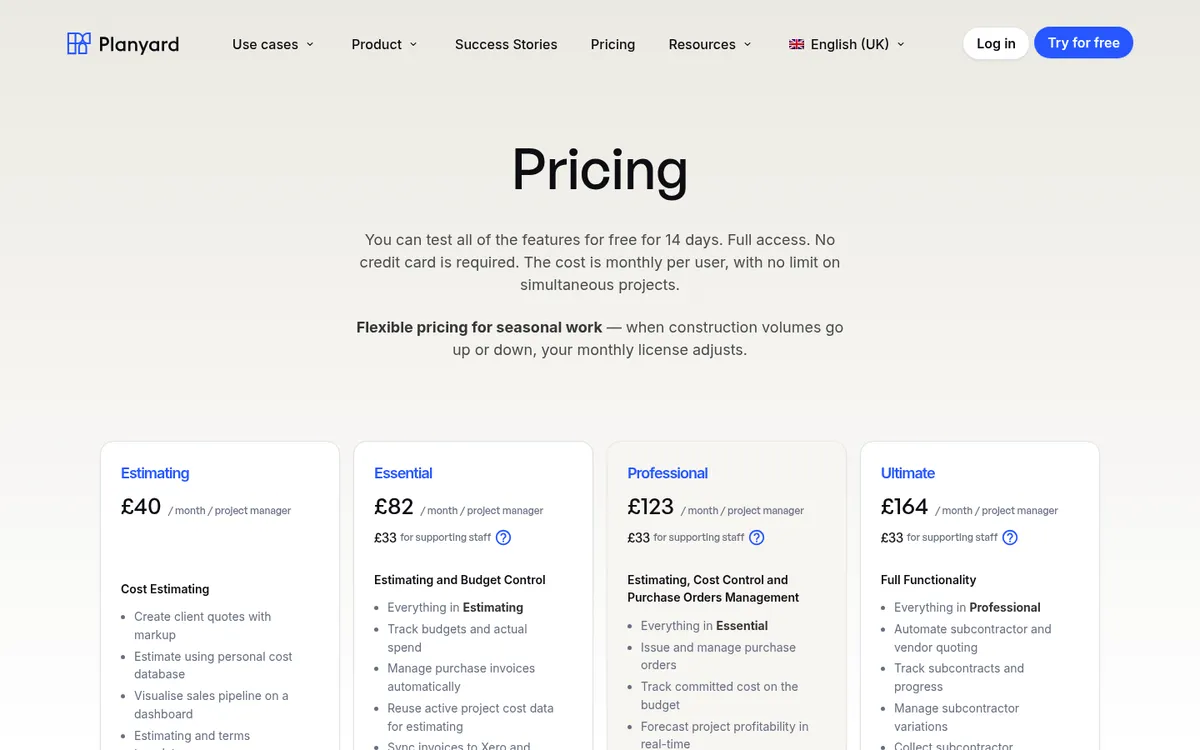
Planyard is construction cost control software for SME main contractors and developers. Purchase orders are raised from the project budget: pick the lines, add the items and send the order to the supplier by email. The committed cost lands on the budget line the moment the order is issued, and Planyard flags lines where committed cost passes the budget. Orders can pass through several approval stages before they go out, carry variations and prepayments, and accept part-delivery invoices.
Subcontract orders work the same way, with the contract documents stored on the order, retention set once and booked on every valuation, and variations tracked against the schedule of values. In Ultimate you can also send packages out to tender, compare the bids against the budget and turn the winner into an order in one click. Supplier invoices are matched to their order, approved, and synced to Xero, QuickBooks or Sage.
Best for: UK main contractors and developers running several projects who want orders, subcontracts and cost reports in one place, on top of the accounting software they already use.
Watch out for: Planyard is not an ERP: payroll, CIS returns and the ledger stay in Xero, QuickBooks or Sage. It has no supplier marketplace or prequalification database, so you invite your own supply chain. Subcontract orders and tendering are in the top plan.
Pricing: Purchase orders are in Professional at £123 per project manager per month. Subcontract orders, subcontractor valuations and tendering are in Ultimate at £164. Supporting staff cost £33. 14-day free trial, see pricing.
"Everything has a PO linked to a job number. No one does a job without a purchase order, so when I look at margin I know it’s the true margin."
Read more
2. Access Coins Evo – Best for Contractors Who Want Procurement Inside a Full ERP
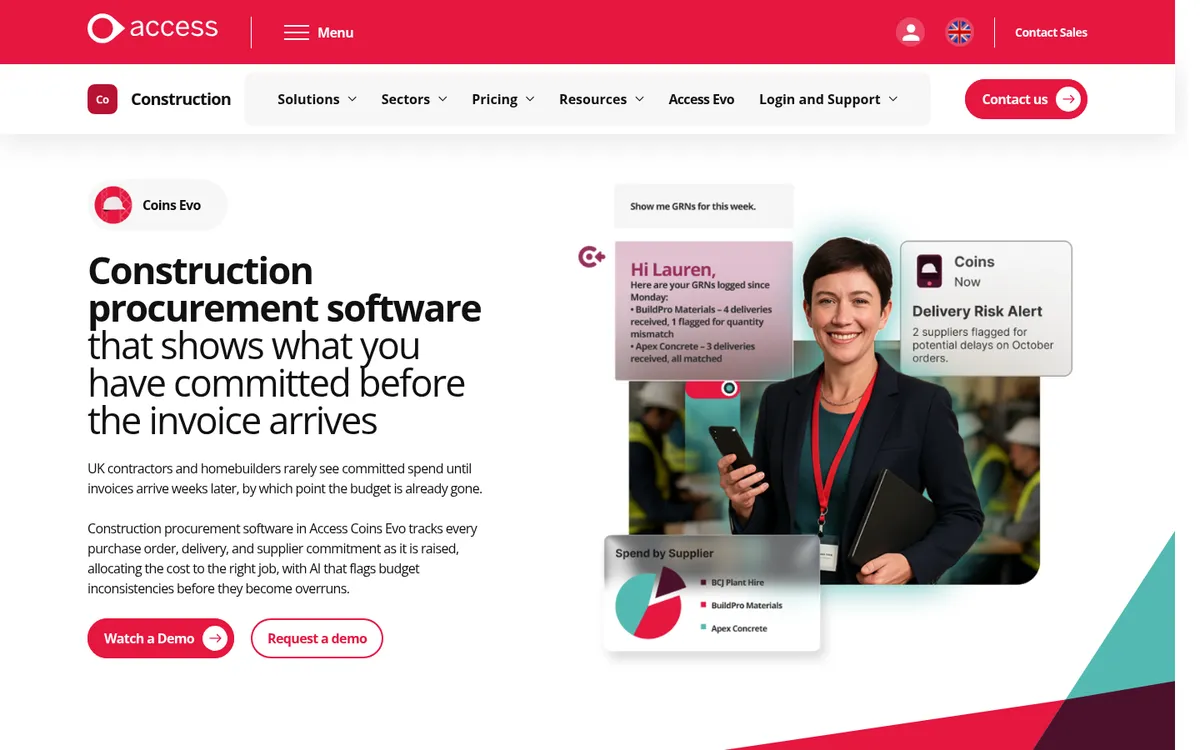
Access Coins Evo is a modular construction ERP used by large UK contractors and housebuilders. Its procurement module records each purchase order as it is raised, allocates the cost to the job and cost code, and updates committed cost, the cash forecast and the CVR from that one action. Budget checks and layered approvals sit in front of each commitment, and Access says its AI flags budget inconsistencies before they become overruns.
Because ledgers, payroll, CIS and plant sit in the same system, there is no sync to manage. The trade-off is the size of the project: Coins is an ERP implementation, not a tool you switch on in a week. See Access Coins vs Planyard and Access Coins alternatives.
Best for: Mid-sized and large contractors and housebuilders with a finance team, replacing several systems at once.
Watch out for: Long implementation and a quote-based price per user. Tendering runs in a separate Access product, ConQuest.
Pricing: Quote only. Access prices per user, with annual, quarterly or monthly billing.
3. Archdesk – Best for a Single Platform With Three-Way Matching
Archdesk is a construction ERP with a procurement module that commits subcontract packages and purchase orders against their budget lines through multi-level approvals. It runs RFQs with bid comparison and evaluation matrices, tracks deliveries to site, and does three-way matching of invoice, order and delivery record. Retention stays on each subcontract through to release, and the figures feed budget against actual and the CVR.
It also covers CRM, estimating, site forms, HR and more, so much of what you pay for sits outside procurement. Archdesk syncs with Xero as a certified partner and connects to QuickBooks, Sage and larger ERPs. See Archdesk vs Planyard.
Best for: Mid-sized contractors that want procurement, project management and finance tracking in one system and have time for a proper rollout.
Watch out for: Priced by quote, and a bigger implementation than a cost control tool. If you only need orders on the budget, much of the platform will go unused.
Pricing: Quote only. Archdesk prices on a fixed number of users or an unlimited-user package based on annual construction volume.
4. Procore – Best for Firms Already Running Projects on Procore
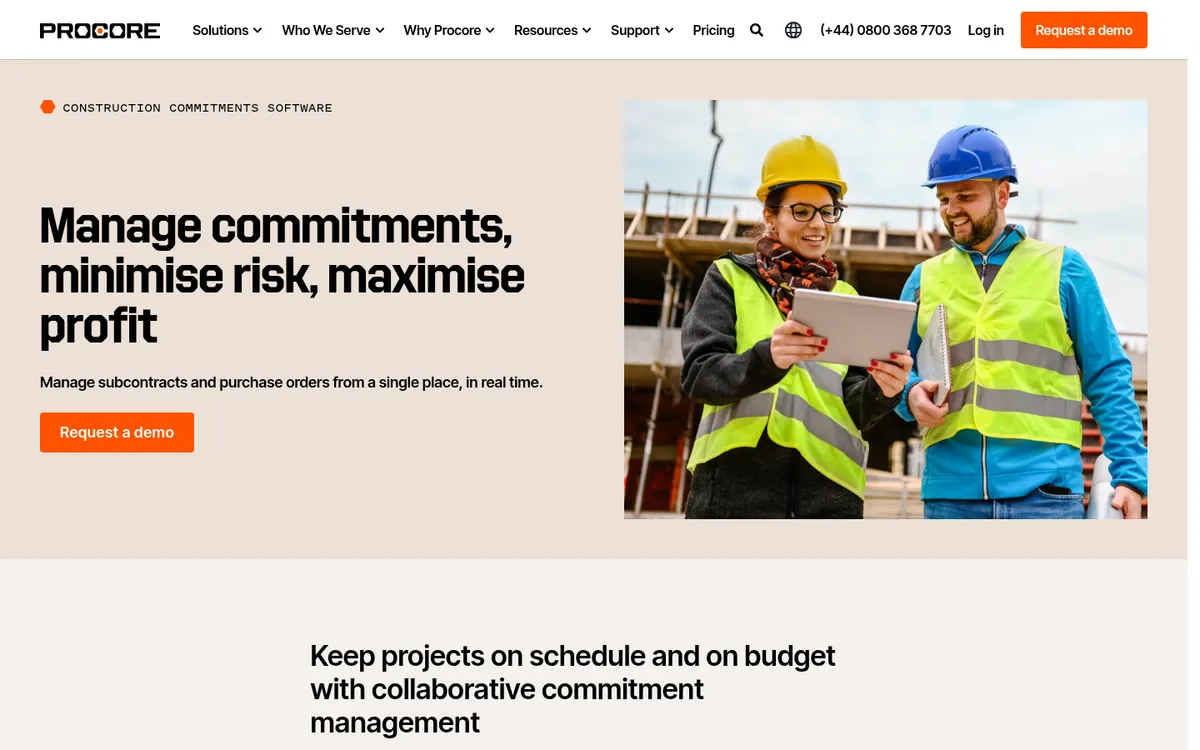
Procore’s Commitments tool holds subcontracts and purchase orders for each project, shows their current value and status, and feeds committed, pending and projected costs into the Procore budget. Connected to Procore Invoice Management, subcontractors can raise their invoices inside Procore for approval. Tendering runs in a separate Procore module, and a winning bid can be turned into a commitment.
Procore is strongest when the whole project team already works in it, because every user is included. For accounting it connects to Xero through the Xero App Store and to Sage Intacct through a connector. See Procore vs Planyard and Procore alternatives.
Best for: Larger contractors that use Procore for project management and want commitments in the same place.
Watch out for: Priced on annual construction volume, so the cost grows with turnover. Smaller contractors often find the setup heavy for what they need from procurement.
Pricing: Quote only. Procore charges an annual fee per product based on the value of construction work you run through it, with unlimited users.
Raise your next order against the budget
Purchase orders and subcontract orders from the budget line, committed cost on the cost report the same day, invoices matched before they reach Xero, QuickBooks or Sage. 14-day free trial.
5. Causeway – Best for Tier 1 and 2 Contractors Standardising the Supply Chain
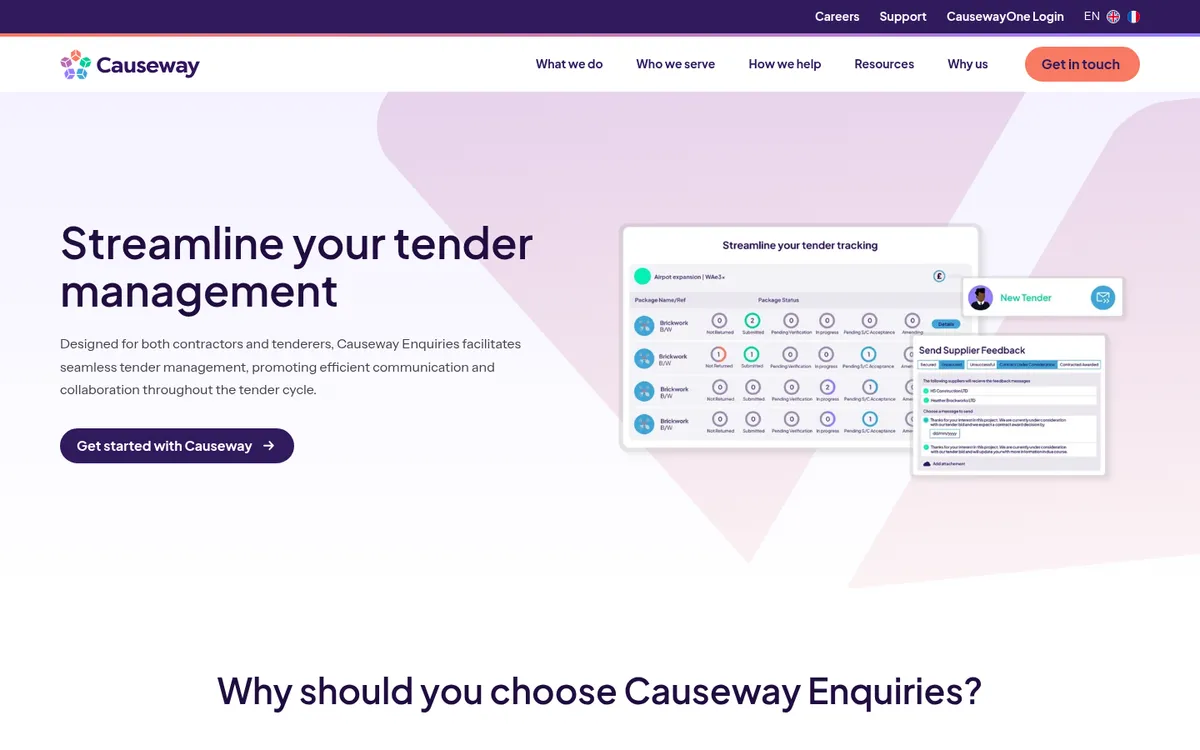
Causeway sells procurement as a set of products. Causeway Enquiries runs trade package tenders and bid comparison. Causeway Supplier Management handles onboarding, prequalification questionnaires and daily checks on insurance and accreditations. CausewayOne e-Invoicing (formerly Tradex) receives supplier invoices and checks them against the purchase order and the buyer’s rules before they reach accounts.
Large contractors use these alongside their own ERP, so Causeway suits a firm that already has a finance system and wants to tighten tendering, supplier compliance and invoice processing around it.
Best for: Large contractors with many trade packages and a dedicated supply chain team.
Watch out for: Several separate products to buy and connect. Purchase orders themselves are raised in your ERP, so Causeway is not an order-to-budget tool for an SME.
Pricing: Quote only.
6. Constructionline – Best for a Prequalified UK Supply Chain
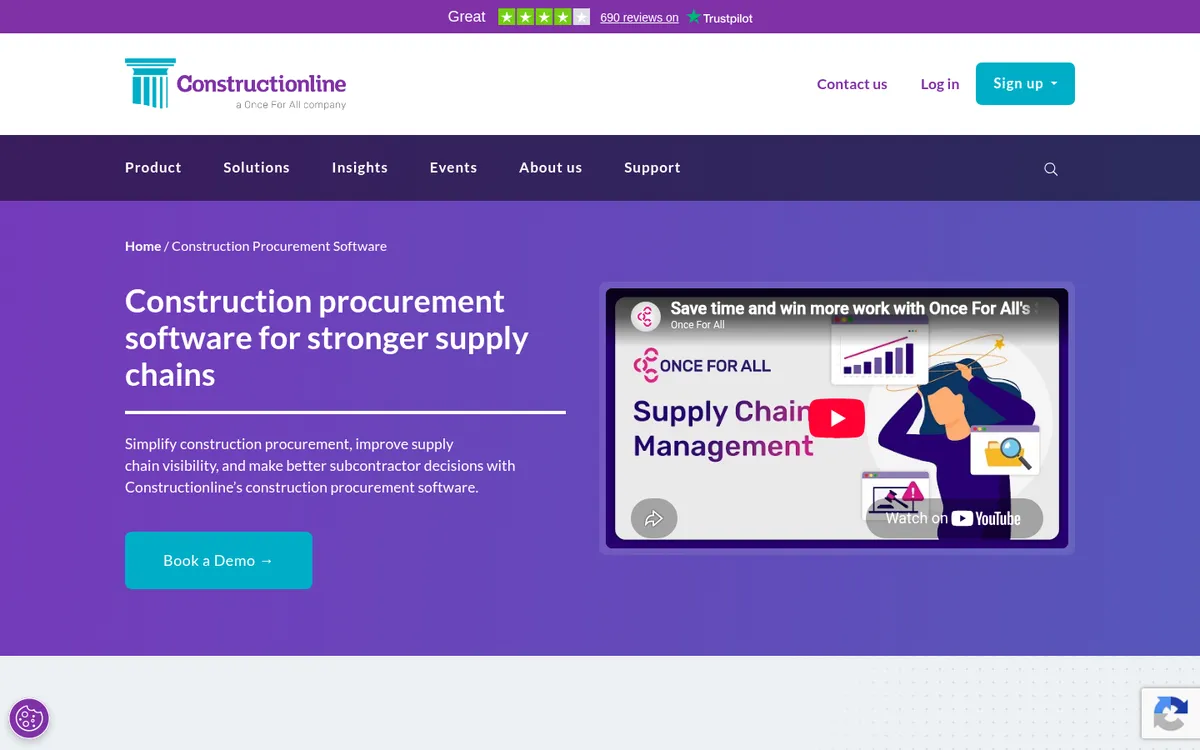
Constructionline is the UK’s best-known prequalification register, with around 70,000 registered suppliers. For buyers it offers procurement software to find and invite suppliers, check their compliance against the Common Assessment Standard and Building Safety Act requirements, monitor supply chain risk and run tenders through its Tender Management product (formerly BidWork).
It does not raise purchase orders or track committed cost, so most contractors use it next to an order and cost control tool: Constructionline to decide who you can buy from, another system to control what you buy.
Best for: Main contractors and public sector buyers who need evidence that every subcontractor is vetted.
Watch out for: No orders, budgets or invoice checks. The supplier side pays its own membership fee, which some small trades resist.
Pricing: Quote only for buyers. Supplier membership is charged by turnover band; Constructionline’s FAQ says it starts from £399 a year plus a one-off joining fee.
7. ProcurePro – Best for a Dedicated Procurement Team

ProcurePro is built around the procurement schedule: every package on a project, when it needs to be let and where it stands. It adds a scope of works library, tenders with price breakdowns, compare-and-recommend reports for sign-off, contracts with eSignature and vendor records. Its BidLevel tool reads supplier quotes and pulls out prices and exclusions with AI.
ProcurePro sells in both Australia and the UK and publishes supply terms for each. It integrates with Procore, Aconex and Viewpoint Jobpac, so it suits contractors who already run project management and finance elsewhere and want a specialist tool for the letting process.
Best for: Contractors with procurement managers letting many packages per project, in the UK or Australia.
Watch out for: It stops at the contract: purchase orders, committed cost against the budget and invoice checks live in your other systems.
Pricing: Quote only.
8. The Build Chain – Best for Materials Quotes From Local Merchants
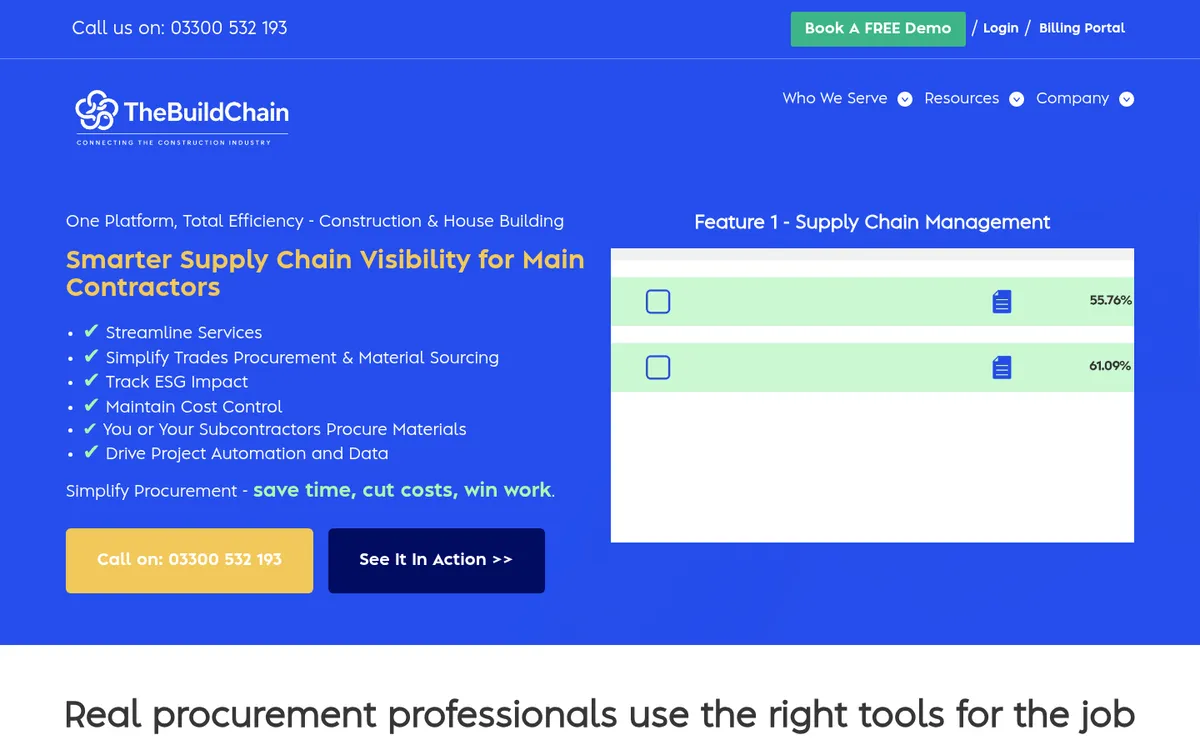
The Build Chain is a UK materials purchasing platform. You send an enquiry once and get quotes from a network of more than 500 merchant branches, compare them side by side, and keep orders and supplier communication in one place. Each quote shows an estimated carbon saving based on delivery distance, which helps with Scope 3 reporting.
It charges a subscription and no commission on what you buy. It covers materials only, so subcontract orders, retention and the project budget sit elsewhere.
Best for: Buyers and subcontractors who spend a lot of time ringing round merchants for prices.
Watch out for: Materials sourcing only, with no budget or subcontract control. The minimum contract is six months.
Pricing: Monthly plan £200 per month on a six-month minimum for one user; yearly £1,200 for one user, or £5,000 a year for unlimited users.
How to Choose
You are an SME main contractor or developer on Xero, QuickBooks or Sage: start with purchase orders against the budget. That is where most of the uncontrolled spend sits, and Planyard adds it on top of your accounting software with a published price. Our purchase order software guide compares the order-only tools in more detail.
You are replacing your finance system as well: look at Access Coins Evo or Archdesk, and budget for a rollout measured in months.
Your projects already run in Procore: use its Commitments tool, and add a specialist like ProcurePro if you have a procurement team letting many packages.
Your main worry is who you buy from: Constructionline or Causeway Supplier Management handle prequalification and compliance, next to whatever controls the orders.
You buy a lot of materials from merchants: The Build Chain shortens the ring-round for quotes.
Australian contractors face the same choice. ProcurePro, Procore and Planyard all sell in Australia; Planyard publishes AUD prices on its Australian pricing page and syncs with Xero, QuickBooks and MYOB.
"I’ve used other systems in the past that you need 3 or 4 days of training before you can even raise a purchase order on the system. With Planyard, you can just raise your first purchase order in 5 minutes in one go. You just Planyard it!"
Read more
"With Planyard, there's better visibility of everything – from raising the purchase order through to paying all our suppliers and subcontractors, retention management, and sales invoices. At a glance, I can see everything. Before, it was shrouded in a veil of mystery – you had to dig deep and click on five different menus before you got anywhere."
Read more
Next Step
If your orders still go out by phone and email, run the next one through Planyard: raise it from the budget line and watch the committed cost update. Our guide to purchase orders in construction covers how to set the threshold and the approval rules first.
Control procurement on every project
Purchase orders, subcontract orders and tenders tied to the budget, with invoices matched before they reach accounts. 14-day free trial, no credit card.