
It’s month-end, and a commercial manager at a mid-size contractor is pulling together CVR reports from three separate spreadsheets, chasing site teams for labour records, and trying to answer a simple question: are we making money on this job? That scenario – repeated across thousands of UK construction firms every month – is exactly what commercial management exists to solve.
Unlike in the US, where “commercial construction” refers to building types (offices, retail, hotels), in the UK, commercial management is the financial discipline that ensures construction projects are won, delivered, and closed profitably. This guide explains what it covers, who does it, how it works across the project lifecycle, and where modern software fits in.
Definition: What is Commercial Management in Construction?
The Institute of Commercial Management (ICM) defines commercial management as:
“The identification and development of business opportunities and the profitable management of projects and contracts, from inception to completion.”
In UK construction, this translates to the discipline responsible for the financial and contractual control of construction projects. It sits alongside project management and site management as one of the three core functions on any significant build.
Where project management focuses on programme, quality, and coordination, commercial management focuses on money: ensuring costs are controlled, contracts are properly administered, risks are priced, and the business makes the margin it tendered for.
Important distinction: In the US, “commercial construction management” typically means managing the construction of commercial buildings. In the UK, it means managing the commercial (financial) side of any construction project – residential, infrastructure, or commercial. This guide uses the UK definition throughout.
What Does Commercial Management Cover?
Based on the RICS quantity surveying and construction pathway and industry practice, commercial management in construction covers seven core disciplines. Each one feeds into the others – get one wrong and the rest suffer.
Budget Planning, Monitoring, and Forecasting
Setting target costs at the start of a project, tracking actual spend against those targets as work progresses, and forecasting the final project cost. This is the foundation everything else builds on – without a robust budget, there’s nothing to measure commercial performance against.
Estimating, Tendering, and Procurement
Pricing work at tender stage, issuing subcontractor tenders for each trade package, evaluating bids, and awarding orders. The decisions made here lock in the majority of project cost – a poor procurement round can destroy margin before the first brick is laid.
Contract Administration
Managing valuations, variations, claims, and interim payments under JCT, NEC, or bespoke contracts. This is where commercial knowledge of contract law meets day-to-day project reality – every change event needs proper commercial administration to protect entitlement.
Cash Flow Forecasting
Projecting income and expenditure to manage working capital across the project portfolio. Cash flow problems kill contractors that are otherwise profitable on paper – forecasting ensures the business can meet its payment obligations ahead of time.
Risk Management and Value Management
Identifying commercial risks early, pricing contingency into budgets, and actively managing exposure as the project progresses. Value management ensures the client gets what they need at optimal cost – and that the contractor maintains its target margin.
Supply Chain and Subcontractor Management
Managing relationships, performance, and payment across the supply chain. On a typical project, 80% or more of cost flows through subcontractors – how well you manage those relationships directly determines whether the project delivers on budget.
Cost Value Reconciliation (CVR)
Comparing cost against value each month to understand project profitability at any point. The CVR is the commercial team’s primary health check – it tells you whether you’re making or losing money, and by how much. For a detailed breakdown, see how CVR works in construction.
Together, these seven disciplines ensure that a project’s financial performance is actively managed – not just reported after the fact.
"I see Planyard as replacing [Cost Value Reconciliation (CVR)] in businesses."

Key Roles in a Commercial Team
On a typical UK main contractor, the commercial team is structured around these roles:
Commercial Director
Board-level responsibility for the commercial performance of the entire business. Sets commercial strategy, oversees risk across the portfolio, and makes final decisions on major claims, settlements, and contract negotiations.
Commercial Manager
Manages the commercial function across one or more projects. Responsible for commercial strategy at project level, multi-project oversight, team management, and reporting to directors. Often the key decision-maker on variations, claims, and subcontractor disputes.
Quantity Surveyor (Senior / Project QS)
The hands-on commercial role at project level. Manages the budget, processes valuations, administers subcontracts, tracks costs, and produces the CVR. Senior QSs may manage multiple packages or smaller projects independently.
Career Progression
The typical career path runs: QS -> Senior QS -> Commercial Manager -> Commercial Director. In smaller contractors, these roles often overlap significantly – a senior QS may effectively perform the commercial manager function without the formal title.
Understanding the distinction between these roles matters when deciding how to structure your team. For a deeper comparison, see Commercial Manager vs Quantity Surveyor: What’s the Difference?
Commercial Manager vs Quantity Surveyor
This is one of the most common questions in UK construction careers – and the answer depends on company size:
| Aspect | Quantity Surveyor | Commercial Manager |
|---|---|---|
| Focus | Project-level cost and value | Multi-project commercial strategy |
| Scope | Measures, values, costs | Strategy, risk, business development |
| Typical projects | 1-2 projects | 3-6 projects (oversight) |
| Reports to | Commercial Manager or Director | Commercial Director or MD |
| Key output | CVR, valuations, final accounts | Commercial reports, risk registers, strategy papers |
In practice, the overlap is significant – especially in SME contractors where a senior QS often performs both roles. The commercial manager role becomes distinct once a company is running enough projects to require someone dedicated to cross-project commercial strategy and team leadership.
For a detailed breakdown, read our full guide: Commercial Manager vs Quantity Surveyor in Construction.
How Commercial Management Works in Practice
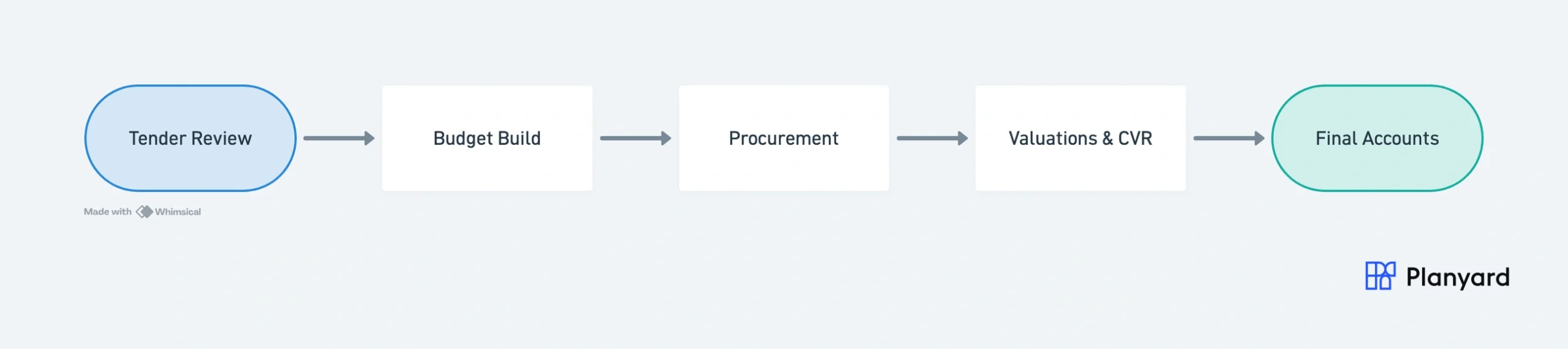
Commercial management spans the entire project lifecycle. The workload shifts at each stage, but the core principle remains the same: know where you stand financially, and act on that knowledge before problems become losses.
Pre-Construction: Setting Up for Success
Before work starts on site, the commercial team assesses the client tender and decides whether to bid. If the decision is to proceed, they develop the project budget from the estimate – breaking costs down into trade packages with clear allowances and contingency.
Procurement starts here too. The commercial team decides which packages to subcontract versus self-deliver, sets procurement timelines, and issues subcontractor tenders. Every risk identified at this stage gets a price – whether that’s difficult ground conditions, a tight programme, or an incomplete design.
Construction Phase: Monthly Commercial Rhythm
Once on site, the commercial team settles into a monthly cycle. Each month they assess work done and prepare client applications for payment, while simultaneously processing subcontractor interim valuations and managing retentions.
The CVR is the centrepiece of this phase – comparing cost against value each month to track whether the project is making or losing money. Every variation gets assessed for cost impact and priced with the client. The cost-to-complete forecast updates as new information emerges, giving directors early warning of any margin erosion. For a step-by-step guide, see how to prepare a CVR in construction.
Post-Construction: Closing Out Profitably
After practical completion, the focus shifts to final accounts – agreeing the final contract sum with both client and subcontractors. This is where the commercial skill really shows: a well-managed final account can recover margin that would otherwise be left on the table.
The team also manages defects liability periods and ensures retentions are released on time. Finally, actual cost data gets fed back to estimating so future bids reflect real performance rather than assumptions.
"With our old system, we were duplicating all our work – inputting information, running a report, extracting it out, and then inputting again. With Planyard, we can have all the information at a click of a button. The time saving has been massive."
Read more
Get live commercial visibility across all projects
Replace month-end spreadsheet marathons with real-time CVRs and budget tracking. No credit card required.
Common Challenges for Commercial Teams
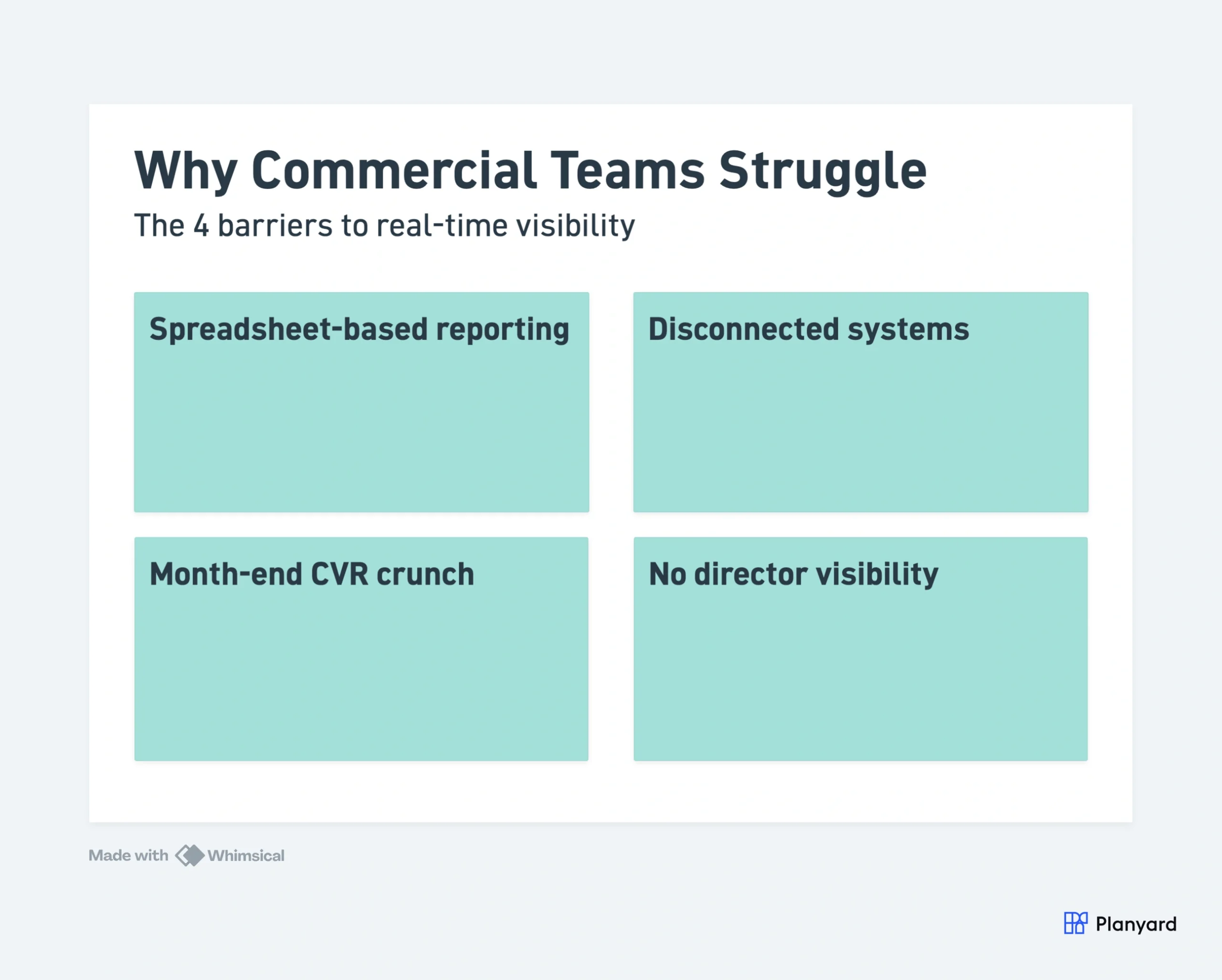
Despite its importance, commercial management in construction is often hampered by outdated processes and disconnected tools. These are the challenges we hear most often from QSs and commercial managers.
Spreadsheet-Based Reporting
CVRs and budget reports compiled manually in Excel are time-consuming, error-prone, and out of date the moment they’re produced. A mid-size project QS can spend two to three days each month just assembling the numbers – time that should be spent actually managing costs.
Disconnected Systems
Site teams, commercial teams, and finance all working from different data sources with no single source of truth. When a subcontractor invoice is approved on site, it might take days or weeks before the QS sees it reflected in their budget tracking.
The Month-End CVR Crunch
Days spent pulling data together for a monthly report that should be available in real time. The irony is that by the time the report is complete and reviewed, the data is already stale – decisions get made on last month’s reality.
No Real-Time Visibility for Directors
Commercial directors and MDs can’t see portfolio performance without requesting reports from every project QS. This creates a dangerous blind spot – problems only surface when they’ve already become costly.
"Planyard gives our MD a chance to make good, informed decisions, whereas before he was worried about making those decisions because he didn't really know where we were. Even when we can see difficult times ahead, at least we can plan for them now."
Read more
Version Control on Budgets
Multiple versions of the same budget floating between email, shared drives, and personal spreadsheets. Nobody is entirely sure which version is current, and reconciling differences after the fact wastes hours that could be spent on actual commercial management.
These challenges compound as a contractor grows. What works for one or two projects becomes unmanageable at five or ten. For a deeper dive, see 5 Biggest Challenges for Construction Commercial Teams.
"Without a proper system, you are essentially flying blind. You wouldn't know if there was a problem until it was too late, and you wouldn't truly know if you had made a profit until the project was already finished."
Read more
How Software Supports Commercial Management
Modern commercial management software replaces the patchwork of spreadsheets, emails, and disconnected systems with a single workflow that connects budgets, procurement, contracts, invoices, and reporting. When evaluating tools for your commercial team, these are the capabilities that matter most.
Live Budget Visibility
Budgets that update automatically when orders are placed, valuations are approved, or invoices are processed. No more waiting until month-end to know where you stand – the numbers are always current.
Committed Cost Tracking
See what’s financially locked in before invoices arrive, not just what’s been paid. When a subcontract order is issued, that commitment appears immediately in the budget – giving you the full picture of exposure, not just historical spend.
Integrated CVR
Cost value reconciliation that builds itself from live project data rather than a manual monthly exercise. The numbers update as costs and valuations flow through – turning the CVR from a monthly event into an always-current dashboard.
Subcontractor Workflow
Tenders, orders, valuations, and payments managed in one place with a clear audit trail. Subcontractors submit applications directly into the system, eliminating lost emails and manual data entry.
Accounting Integration
Approved costs flow to Xero, QuickBooks, or Sage without double entry. The commercial team works in their tool, the finance team works in theirs, and the data stays in sync automatically.
Portfolio-Level Reporting
Directors see cross-project performance without waiting for individual QS reports. One view shows budget health, margin trajectory, and cash flow across every live project – the kind of visibility that used to require a week of phone calls.
The goal isn’t to add another system to the pile – it’s to give commercial teams a single place where their existing workflow (budgets, procurement, payments, reporting) happens naturally, with live data replacing manual reporting.
For a detailed look at how commercial managers track project budgets in practice, or to explore purpose-built tools, see our guide to commercial construction management software.
"Planyard takes your project budget and puts it very clearly on screen, allowing you to account for all your costs, invoices, and receipts as you process them before they even reach the accounting department. This gives you a live, real-time picture of exactly where your project budget stands at any given point."
Read more
Further Reading
- Commercial Manager vs Quantity Surveyor: What’s the Difference?
- 5 Biggest Challenges for Construction Commercial Teams
- How Commercial Managers Track Project Budgets
- Construction Cost Value Reconciliation (CVRs) Explained
- Free CVR Template for Excel
- Best Construction Budgeting Software
- Commercial Construction Management Software
Built for construction commercial teams
Planyard gives QSs and commercial managers live budget, CVR, and cash flow data – no more month-end spreadsheet marathons.