
The difference = scope. A QS manages cost at project level. A CM takes strategic oversight across multiple projects with P&L responsibility. In smaller contractors one person does both – the roles split once you’re running three or more jobs.
Five years in as a QS and someone mentions a Commercial Manager vacancy – step up or different job? Or you’re hiring and not sure which role you need. This guide covers responsibilities, skills, career path, and salary.
The Quick Answer
A Quantity Surveyor manages project-level numbers – measuring work, valuing it, tracking costs, producing the monthly CVR. A Commercial Manager takes the broader view: multi-project oversight, commercial strategy, risk management, team leadership, P&L responsibility.
The QS tells you where the money is on each project. The CM decides what to do about it across the business.
Under £20m turnover, one person does both. The split becomes real once strategy demands more attention than project detail.
What Does a Quantity Surveyor Do?
The QS owns project-level numbers. Their job: know what the project has cost, what it’s worth, and where it’s forecast to finish.
It starts with breaking the tender into trade packages. From there, the QS lives in a monthly cycle: measure subcontractor work, agree interim payments, manage retentions, record actuals against budget.
Variations are constant – every change needs pricing, the claim submitted, the budget adjusted. All feeds the monthly CVR. The QS also prepares payment applications and agrees final accounts at project close.
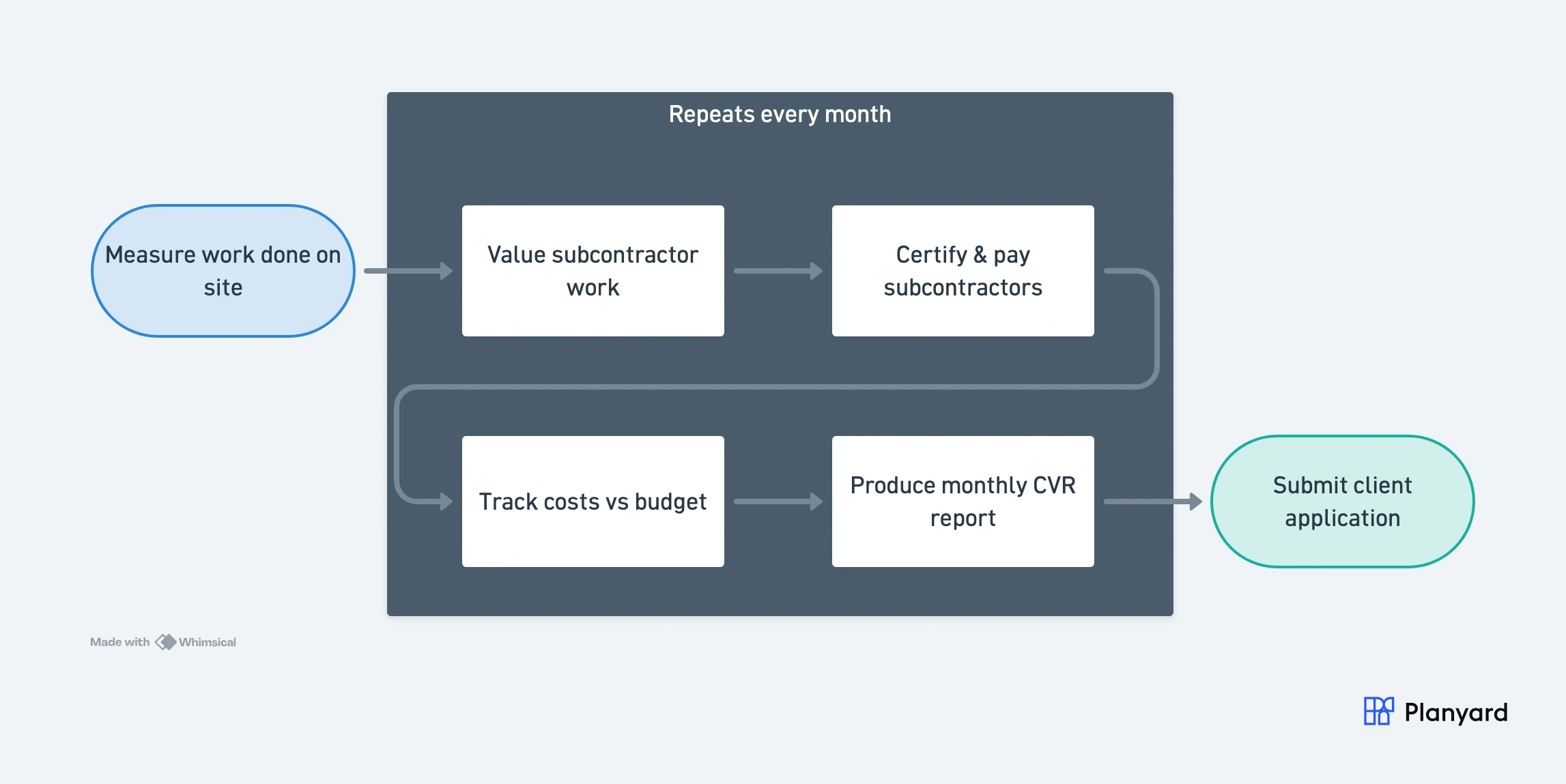
Typical Scope
A QS typically manages one to two projects depending on size. On a £5m project, one QS handles the full commercial workload. On a £30m job, a senior QS manages overall position with one or two assistants on specific packages.
Reports to the Commercial Manager (or Commercial Director in smaller firms). Primary output: accurate, timely financial data that enables commercial decisions. For CVR detail, see CVRs in construction explained.
"I’ve used other systems in the past that you need 3 or 4 days of training before you can even raise a purchase order on the system. With Planyard, you can just raise your first purchase order in 5 minutes in one go. You just Planyard it!"
Read more
What Does a Commercial Manager Do?
The CM operates at a higher level – reviewing forecasts across three to six projects, challenging assumptions, spotting trends, deciding where to intervene. They set procurement strategy, allocate risk, and build subcontractor relationships across the portfolio.
Risk management sits on their desk. Subcontract awards need sign-off. Disputes beyond QS level land here. Then people: leading QSs, reviewing work, mentoring juniors, producing commercial reports for board meetings.
Typical Scope
A CM oversees three to six projects and two to five QSs. Less involved in measurement – more focused on decisions, risk, and team performance.
Reports to Commercial Director or MD with P&L responsibility. Where a QS asks “what has this cost?”, the CM asks “what should we do about it?”
For the full lifecycle view, see What is Commercial Management in Construction?
Day-to-Day Comparison
The easiest way to see the difference – compare a typical day:
| Aspect | Quantity Surveyor | Commercial Manager |
|---|---|---|
| Scope | Single project (or 2 smaller ones) | 3-6 projects / business unit |
| Key output | Monthly CVR, valuations, final accounts | Commercial reports, risk register, strategy |
| Subcontractor interaction | Valuations, payments, account meetings | Award strategy, disputes, key negotiations |
| Client interaction | Interim applications, variation submissions | Commercial negotiations, dispute resolution |
| Reports to | Commercial Manager or Director | Commercial Director or MD |
| Focus | Accuracy of cost and value data | Profitability and commercial risk |
| Meetings | Site meetings, subcontractor reviews | Board reviews, project commercial reviews |
| Decision authority | Day-to-day cost decisions within budget | Procurement awards, strategy, escalations |
"Planyard can save about 15 minutes per subcontractor payment. When I'm dealing with 50 subcontractors, that's 10 to 12 hours a month. Add the CVR reporting and all of a sudden I've got two extra days free."
Read more
Where the Roles Overlap
In practice, the boundary isn’t always clean – particularly in SME contractors. In firms under £20m turnover, the senior QS effectively performs both roles. Both need strong understanding of JCT, NEC, and bespoke contract forms. Both contribute to the monthly commercial review. Both use the same systems – the difference is what decisions they make from the data.
The overlap is most visible during growth phases, when a contractor needs a CM but hasn’t made the hire. The senior QS stretches to cover strategic decisions while doing project-level work – and something inevitably suffers.
Career Progression: QS to Commercial Manager
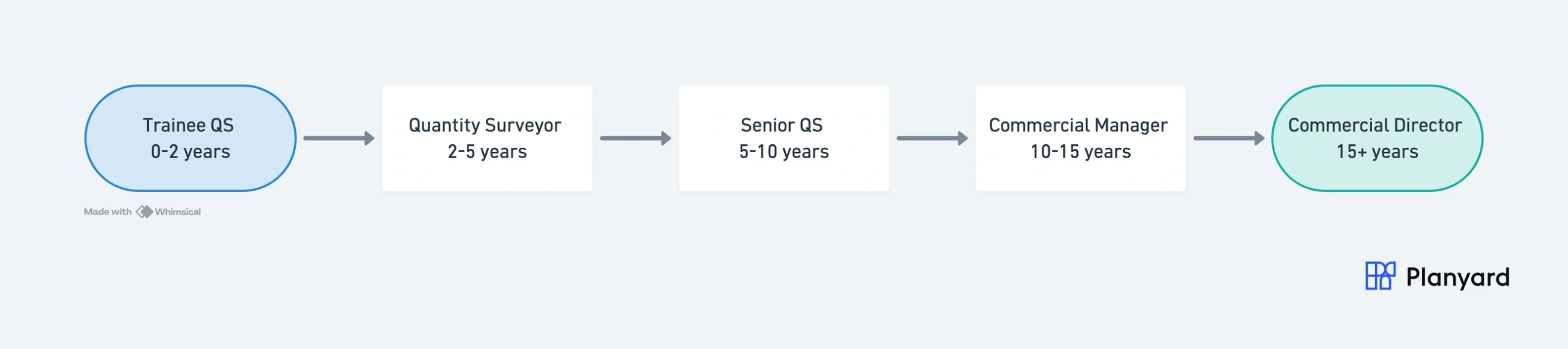
The most common route into commercial management is through quantity surveying. The typical UK career path looks like this:
- Trainee QS (0-2 years) – Learning measurement, cost tracking, basic valuations under supervision
- Quantity Surveyor (2-5 years) – Managing packages independently, producing CVRs, handling variations
- Senior QS (5-10 years) – Running full project commercial positions, mentoring juniors, MRICS chartership
- Commercial Manager (10-15 years) – Multi-project oversight, team leadership, strategic decisions
- Commercial Director (15+ years) – Board-level responsibility for business commercial performance
What Changes at the CM Level
The transition from Senior QS to CM is less about new technical skills and more about perspective shift. You stop producing data and start acting on it. That means: trusting your QSs’ numbers, making portfolio-level decisions, using contract knowledge for commercial leverage (not just compliance), and becoming responsible for other people’s development.
Qualifications
At QS level, MRICS is the gold standard. At CM level, MCIOB is equally common. But at this seniority, experience matters more than letters. A CM who has managed £100m+ of projects commercially will always outweigh perfect qualifications with limited practical experience.
Built for QSs and commercial managers
Whether you're managing one project or ten, Planyard gives your commercial team live budget visibility without the month-end spreadsheet crunch.
Skills Comparison
Both roles share a foundation of contract law, negotiation, and financial accuracy. A QS’s edge: technical precision – measurement, cost analysis, valuation methodology. A small error compounds over months.
A CM’s edge: strategic thinking over calculation speed. People management becomes central. Stakeholder management – presenting to directors, managing client relationships – becomes weekly rather than occasional.
How Software Supports Both Roles
The QS’s frustration with spreadsheets: two days assembling a CVR that’s stale by the time it reaches the CM. What they need is costs updating as they work – raise an order, budget reflects it. Process a valuation, CVR recalculates. No month-end assembly.
The CM’s frustration: can’t see portfolio position without chasing individual QSs for reports. What they need is live visibility – which projects are on track, where margin is leaking, what needs attention this week.
The best systems serve both from a single data set. The QS does daily work (orders, valuations, costs) and the CM sees it in real time. That’s the approach Planyard’s construction budgeting software takes: one system where QS workflow feeds directly into the CM’s portfolio view.
"As a construction manager, my work is significantly easier – I can see costs, revenues, and forecasts for every budget line in real-time."
Read more
When Does a Contractor Need a Commercial Manager?
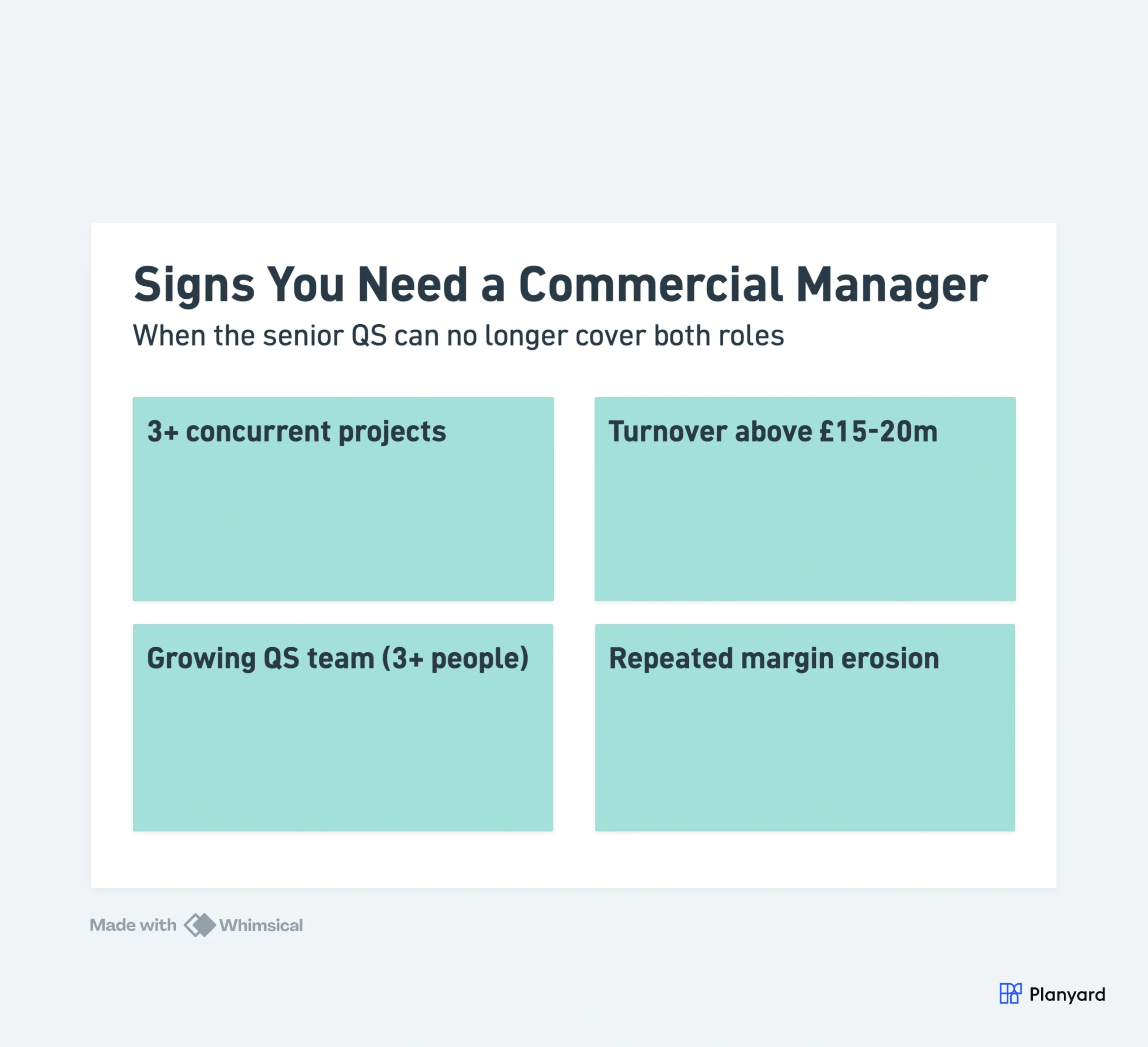
Not every contractor needs a dedicated CM. Triggers:
- 3+ concurrent projects: When the portfolio gets too large for any single person to maintain project-level detail while also making strategic decisions
- Turnover above £15-20m: The risk profile demands someone focused on commercial strategy rather than just cost tracking
- Growing QS team: When you have 3+ QSs who need management, mentoring, and quality oversight
- Repeated commercial issues: If projects keep delivering below tendered margin, you need strategic commercial oversight
- Director bandwidth: When the Commercial Director can no longer review every project in sufficient depth
Below these thresholds, a strong Senior QS can cover both – especially with good software that automates reporting. Above them, the lack of a CM shows up as margin erosion, inconsistent practices, and QSs making strategic decisions without the experience.
"Planyard gives our MD a chance to make good, informed decisions, whereas before he was worried about making those decisions because he didn't really know where we were. Even when we can see difficult times ahead, at least we can plan for them now."
Read more
Summary
The QS owns the detail. The CM owns the strategy. Both essential – the best teams have clear accountability at both levels with systems that serve each role without duplicating effort.
Considering the step up? The question isn’t whether you’re technically capable – it’s whether you’re ready to let go of detail and think at portfolio level. Deciding whether to hire a CM? The question: are you growing past the point where your senior QS can do both jobs well?
For more on how commercial management works across the project lifecycle, read our pillar guide: What is Commercial Management in Construction?
Give your commercial team real-time visibility
Planyard connects QS workflows to CM dashboards – live budgets, automated CVRs, and portfolio oversight in one system.