
Procore does not publish its prices, so every customer gets a quote. Reported benchmarks start at about $375 a month and reach $3,000 a month for bigger setups, and annual fees for larger firms can exceed $20,000. What you pay depends mainly on your annual construction volume and the modules you pick.
How Procore’s Pricing Model Works
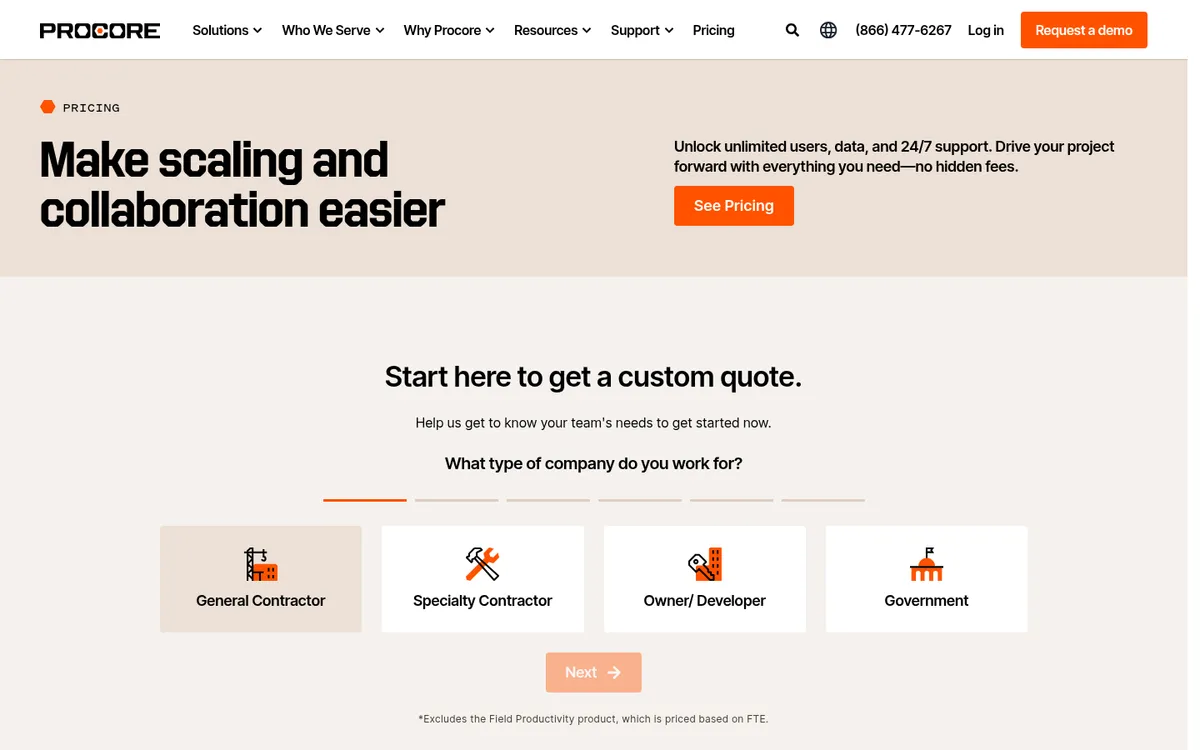
Procore sells an annual contract and quotes each customer separately. The pricing page has no price list, only a short form that leads to a custom quote.
The quote is based on your annual construction volume, meaning the value of the work you run through Procore in a year. Users are unlimited, so adding a site manager or an accounts clerk doesn’t change the price. Each module you add does.
Larger firms can spread that cost across many people and projects. A small contractor pays for a platform built for bigger teams, and feels it more.
Factors That Influence the Cost of Procore Construction Software
A Procore quote moves with a handful of inputs:
| Factor | Effect on the quote |
|---|---|
| Annual construction volume | The main basis of the price. More work through the platform means a higher quote. |
| Modules | Each product you add, such as project management or financials, raises the fee. |
| Project size and number | Bigger and more numerous jobs push up your construction volume. |
| Users | Unlimited, so team size doesn’t change the price. |
| Setup, customisation and training | Usually billed separately from the subscription. |
Ask for a quote on the modules you would actually use in the first year. It’s easy to sign up for a bundle and pay for tools nobody opens.
"The price is likely what initially drew us in because it was at a level where we felt comfortable saying, 'Let’s try it.' It wasn't a massive financial investment, so if it didn't work, we wouldn't have lost tens of thousands of pounds. We honestly wouldn't have even considered it if there had been a £10,000 upfront cost, but the subscription model—paying a manageable amount every month—allowed us to test it and see if it fit the business. The answer was a clear yes, so we’ve kept going."
Read more
How Much Does Procore Cost per Month and per Year?
Because Procore keeps its prices private, the only benchmarks are figures reported by industry sources:
| Reported cost | |
|---|---|
| Per month | From about $375, up to around $3,000 with more modules |
| Per year, low end | About $4,500 |
| Per year, larger firms | Over $20,000 |
Medium and large firms tend to say the workflow gains across many projects justify the cost. Smaller contractors, with fewer projects or a small team, are the ones who find the price hard to swallow.
Need job cost control without a Procore-sized contract?
Planyard tracks budgets, invoices and forecasts per job and syncs with Xero, QuickBooks or Sage. Monthly pricing and a 14-day free trial.
Hidden Costs of Procore
The subscription isn’t the whole bill. When you budget for Procore, add these:
- Onboarding, setup and training, which are often charged separately
- Modules you add later, each of which raises the subscription
- Price increases at renewal, as with many software subscriptions
- Connecting your accounting software or other tools, which can carry its own fees
Planyard: A Flexible Alternative for Cost Management
Planyard is our product, so read this section with that in mind. It does a narrower job than Procore: budgets, cost tracking and forecasts for contractors. It has no scheduling, drawings or field tools, so if you need those, Procore or a similar platform still makes sense.
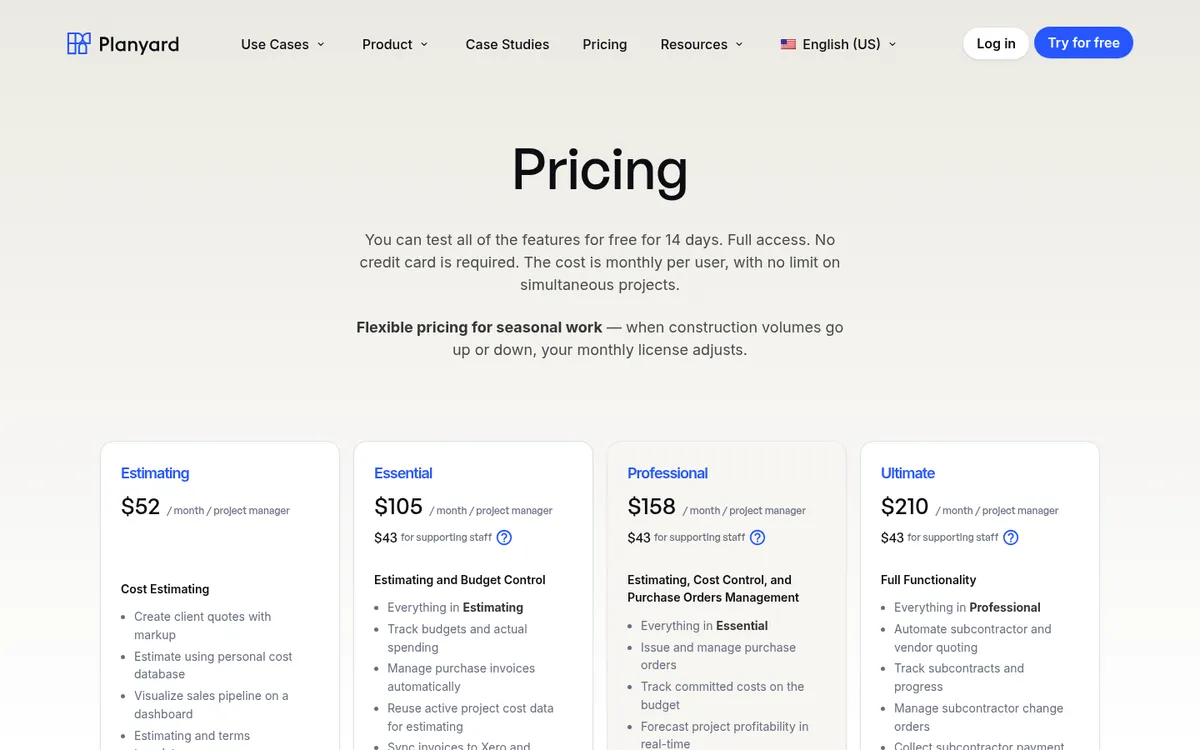
Prices are published and charged monthly per project manager: Estimating $52, Essential $105, Professional $158 and Ultimate $210, with supporting staff at $43. There is no upfront fee, and you invite or remove people as your projects change.
"The price was obviously a major factor. Beyond that, there was more detail provided and a better price point than the alternatives—and you were right at the top of the list on Google."
Read more
Setup takes hours, without consultants. The Keane Group case study describes how one Australian builder got started.
Once running, Planyard keeps budgets, actual costs and forecasts for each project in one place. The numbers update as invoices come in, and the repetitive data entry is automated.
"We've found that user adoption is excellent. After a simple demo and watching a couple of Planyard videos, most people would actually manage to get started with very little additional support."
Read more
Procore or Planyard: Which Fits Your Firm?
If you need scheduling, drawings, site tools and document control across many projects, and your volume can carry an annual contract, Procore is built for that. If your main problem is knowing where each job’s money is going, a cost-control tool costs less and takes less time to set up.
See where every job's money goes
Planyard is the lighter option for contractors who find Procore too big: budgets, committed costs and forecasts, synced with Xero, QuickBooks or Sage. 14-day free trial, no credit card.