
Last verified: October 2026
You have been winning most of your work through referrals and repeat clients. That pipeline worked when you ran two or three projects a year, but now you need a steadier flow of opportunities, and waiting for the phone to ring will not grow the business. Construction bidding sites let you find and compete for projects beyond your existing network.
This guide compares 14 paid and free construction bidding sites, 12 for US work and two for Canada: federal and state government portals, the networks general contractors use to send invitations to bid, and the private project databases. For each one we checked in October 2026 that it still runs, what it costs, and which kind of contractor it suits. BidClerk, CMD Group and Governmentbids.com no longer run as separate services, so they are now covered under ConstructConnect and BidNet Direct.
Working in the UK? See our guide to the best construction tender websites in the UK.
Benefits of Using Free Construction Bidding Websites
Free bidding sites let you look for work without adding another subscription to your overhead, and for most contractors they are the place to start. Paid databases come later, if you want private projects before the bidder list is set.
1. Cost Savings
- No subscription or pay-per-bid fees, so the money stays in the jobs you already have.
- A sensible starting point for small firms and new businesses.
2. Expanded Opportunities
- Residential, commercial and public work in one place.
- Networks like PlanHub put you in front of general contractors you have not worked with before.
3. Simpler Bid Management
- Even free plans usually track deadlines, documents and addenda for the bids you follow.
- Less time lost to chasing paperwork by email.
4. Visibility to Buyers
- A complete profile with your trade, area and documents means GCs and agencies can find and invite you.
5. Low-Risk Entry Point for New Contractors
- You can learn how bidding works, and which sites suit your trade, before paying for anything.
- Most free portals take minutes to set up: register, choose your trades and location, and the matches arrive by email.
6. Networking Opportunities
- Bidding sites connect contractors, subcontractors and suppliers, which often leads to repeat work.
- UK firms can also get listed in a free directory of UK construction companies, where main contractors search for subcontractors and suppliers by trade and region.
What Are the Best Construction Bidding Sites?
The right site depends on the work you want: federal and state contracts, invitations from general contractors, or early private project leads. Prices are in USD unless stated and come from each provider’s own site in October 2026. “Quote” means the provider does not publish a price.
| Site | Free or paid | Price | Sector | Coverage |
| SAM.gov | Free | $0 | Public (federal) | US |
| PlanHub | Free and paid | Free for GCs and local invitations; sub Premier from $1,999 a year | Private and public commercial | US |
| BuildingConnected | Free and paid | Free to receive invitations; Pro and Bid Board Pro by quote | Private commercial | US and international |
| ConstructConnect | Paid | From $129 a month per market | Public and private | US |
| Dodge One | Paid | Quote | Public and private | US |
| ConstructionWire | Paid | Quote (free trial) | Private commercial | US |
| BidNet Direct | Free and paid | Basic $0; state plans from $599 a year | Public (state and local) | US |
| Construction Bid Source | Free and paid | Free to post ITBs; matching not published | Public and private | US |
| SmartBid | Paid (free for invited subs) | Quote, annual per user | GC bid management | US |
| Bidspeed | Paid | From $79 a month | Public (federal, state, local) | US |
| Bid Ocean | Paid | Lite and Core plans, priced by number of states | Public | US |
| BidCentral | Free and paid | Free; Premium $875 a year | Public and private | British Columbia, Canada |
| Biddingo | Free and paid | Free; Premium Plus CA$250 a year | Public | Canada |
| Buildertrend | Paid | From $499 a month | Residential builder software | US and international |
1. SAM.gov – Best for Federal Contracts
SAM.gov (System for Award Management) is the US government’s official site for federal contract opportunities, including construction. You search open solicitations, presolicitation notices and awards, and you register your business there to get the Unique Entity ID you need before you can bid on federal work.
Federal construction often means large infrastructure, defense and federal building projects, with detailed compliance requirements. Smaller firms usually come in as subcontractors to a prime, and award notices on SAM.gov show you who won what.
Best for: Any contractor who wants federal work, either as a prime or as a subcontractor to one.
Watch out for: Registration takes time and has to be renewed every year. It is free, so ignore anyone who offers to register you for a fee.
Pricing: Free.
2. PlanHub – Best Free Option for Subcontractors
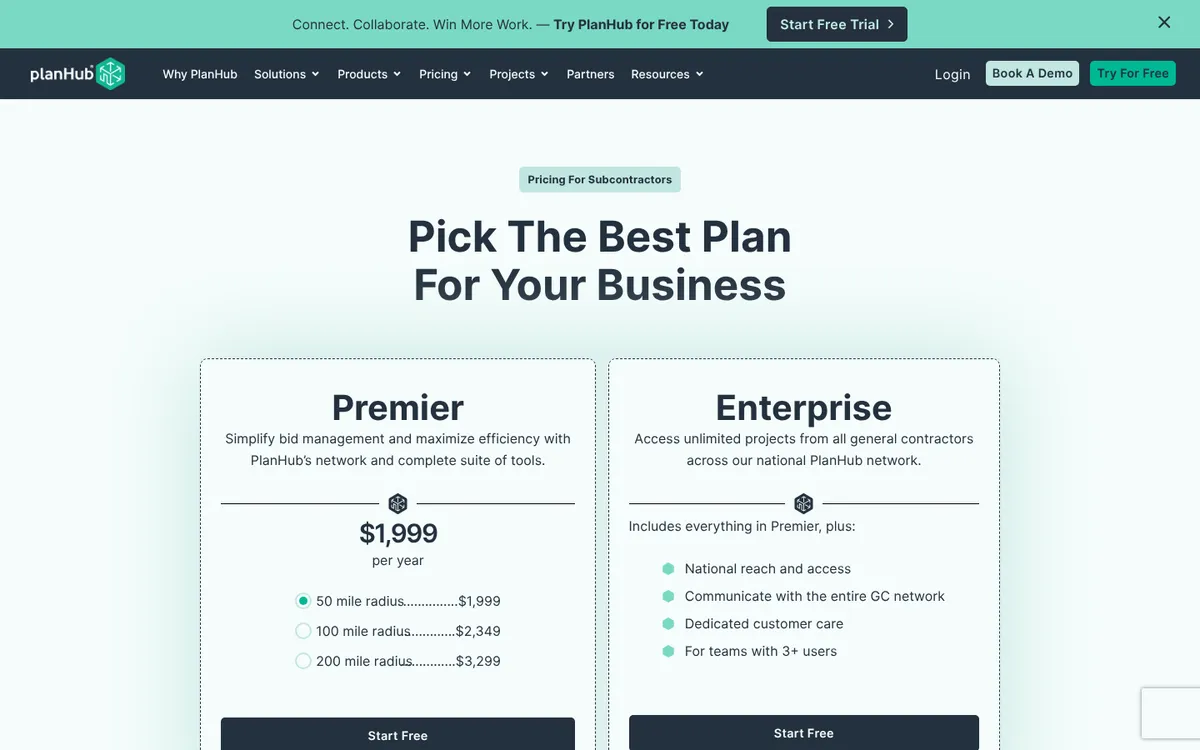
PlanHub connects general contractors with subcontractors and suppliers. GCs post projects and send invitations to bid; subcontractors find projects by trade and location and submit bids. PlanHub says its directory holds more than 400,000 subcontractors and 30,000 suppliers.
General contractors get free, unlimited project posting, basic bid leveling and the subcontractor directory, with paid Pro and Premier tiers on top. Subcontractors can create a free profile, receive direct invitations and bid on projects within a local radius. To search a wider territory you need a Premier subscription.
Best for: Subcontractors who want GC invitations without paying, and GCs who want a free way to send out bid packages.
Watch out for: The free subcontractor tier is limited to a local radius, and paid plans are annual.
Pricing: Free for general contractors (Essentials) and for subcontractor profiles. Subcontractor Premier is $1,999 a year for a 50-mile radius, $2,349 for 100 miles and $3,299 for 200 miles. Enterprise (national reach, three or more users) is by quote.
3. BuildingConnected – Best for Private Commercial Invitations
BuildingConnected is Autodesk’s bid network. Many general contractors use BuildingConnected Pro to send invitations to bid, compare bids and manage subcontractor risk with TradeTapp. Autodesk says the network has more than 1 million construction professionals.
For subcontractors, the value is being in the network where GCs already send their bid packages. Bid Board Pro, the paid subcontractor tool, pulls invitations from different sources into one board, tracks deadlines and adds a plan room for finding new jobs.
Best for: Commercial subcontractors who want invitations from mid-size and large GCs.
Watch out for: No published prices for the paid products, and you mostly see work from GCs who use the platform.
Pricing: Free to receive and respond to invitations. BuildingConnected Pro, Bid Board Pro and TradeTapp are by quote.
4. ConstructConnect – Best Paid Database for Public and Private Leads
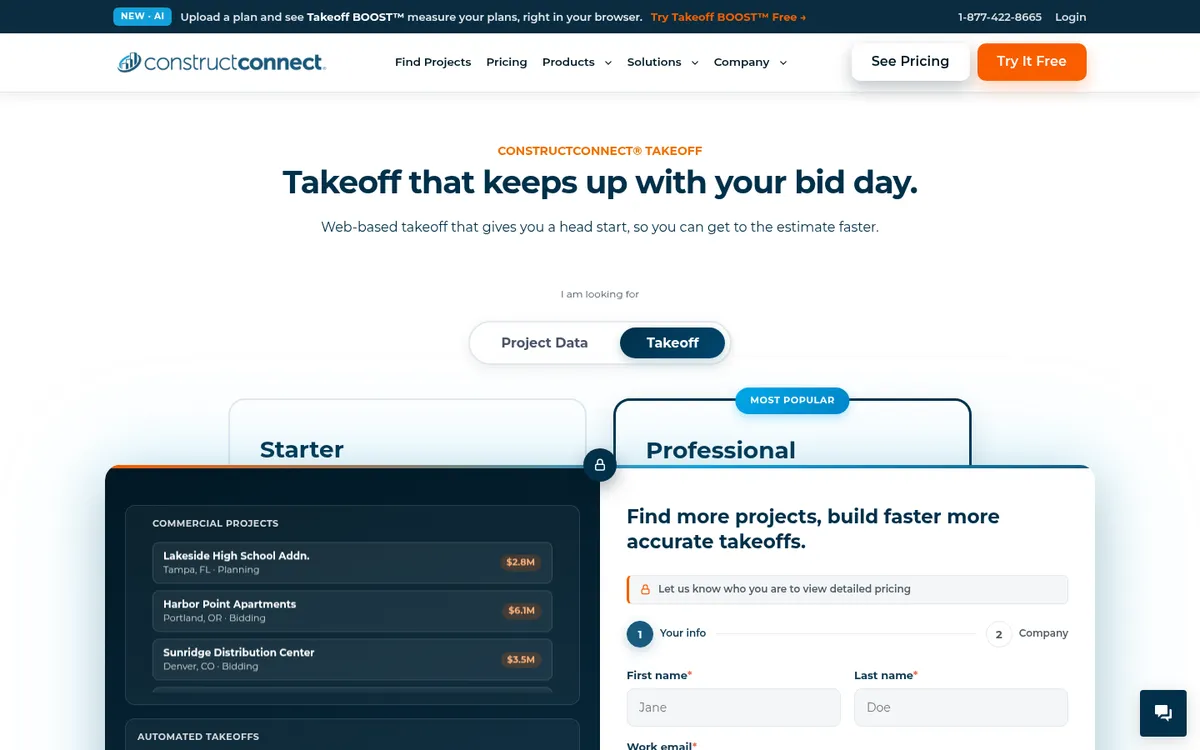
ConstructConnect is one of the largest US project lead databases. It now also owns BidClerk (bidclerk.com shows ConstructConnect’s search and pricing), CMD Group and SmartBid, so if you used any of those, this is where the data lives today.
Project Intelligence covers public and private commercial projects with documents, bidder lists, contacts and a digital bid board, and matches opportunities to your profile. ConstructConnect also offers Bid Center, which it says is free for subcontractors to receive and organize invitations to bid.
Best for: Contractors and suppliers who want public and private commercial leads in one place, with plans and specs attached.
Watch out for: Prices are per market and per seat, so wider coverage adds up. Annual plans cannot be canceled mid-term.
Pricing: Project Intelligence Starter is $129 a month per market, month to month, with 10% off billed annually. Professional starts at $199 a month per market, per seat, billed annually. Premium starts at $10,000 a year.
5. Dodge One – Best for Early-Stage Project Intelligence
Dodge Construction Network has replaced Dodge Construction Central with Dodge One, a rebuilt platform for commercial construction data. Dodge says it tracks more than 636,000 public and private projects a year, from pre-planning through construction, along with spec alerts and The Blue Book Network of contractors.
The point of Dodge is timing. It shows projects in planning and design, before bidder lists are set, so you can build the relationship before the bid drops. That suits firms with someone whose job is business development.
Best for: Mid-size and larger contractors, and product manufacturers, who want to reach owners and designers early.
Watch out for: No published pricing, and the depth of data is more than a small trade contractor bidding local jobs needs.
Pricing: Quote only.
6. ConstructionWire – Best for Private Commercial Real Estate Leads
ConstructionWire tracks private commercial projects such as retail, hospitality, healthcare, multifamily and industrial developments, with contacts for the developers, owners and architects behind them. Projects are grouped by expected start date, from more than 12 months out to the next quarter.
Like Dodge, it is built for reaching decision makers before the bidding phase, but it focuses on private real estate rather than public works.
Best for: Contractors and suppliers who sell into private commercial development.
Watch out for: No public or government projects, and pricing is only available by phone.
Pricing: Quote only. A free trial is available.
Won the bid? Keep the margin you priced.
Planyard turns your estimate into a live project budget, tracks every purchase order and invoice against it, and syncs with QuickBooks or Xero. 14-day free trial.
7. BidNet Direct – Best for State and Local Government Bids
BidNet Direct aggregates government solicitations from state agencies, local municipalities and other public buyers, organized into purchasing groups by state. Governmentbids.com now points to the same BidNet Direct service, so it is covered here.
The free Basic plan lets you see and respond to bids from member agencies and get matches by email. Paid plans add aggregated bids from agencies outside the network, saved searches and a daily summary, for one state, three states or nationwide.
Best for: Contractors bidding public works with cities, counties, school districts and state agencies.
Watch out for: Construction is one category among many, so set your filters carefully. Regional and National plans are annual only.
Pricing: Basic is free. Local (one state) is $599 a year, Regional (three states) $1,199 a year and National $1,999 a year. A federal bids add-on is $149 a year.
8. Construction Bid Source – Best for Subcontractor Outreach on Public Jobs
Construction Bid Source has been running since 1992. It matches construction opportunities to your business type, bidding role, trades and area, and lets general contractors post invitations to bid for free. Many of the listings are primes looking for DBE, MBE and other certified subcontractors and suppliers, and the site helps GCs document good faith outreach.
Best for: Certified small and disadvantaged businesses looking for subcontract work on public projects, and primes who need to reach them.
Watch out for: The subscription price for opportunity matching is not published.
Pricing: Free to post invitations to bid. Opportunity matching is a paid subscription, price not published.
9. SmartBid – Best for General Contractors Managing Subcontractor Bids
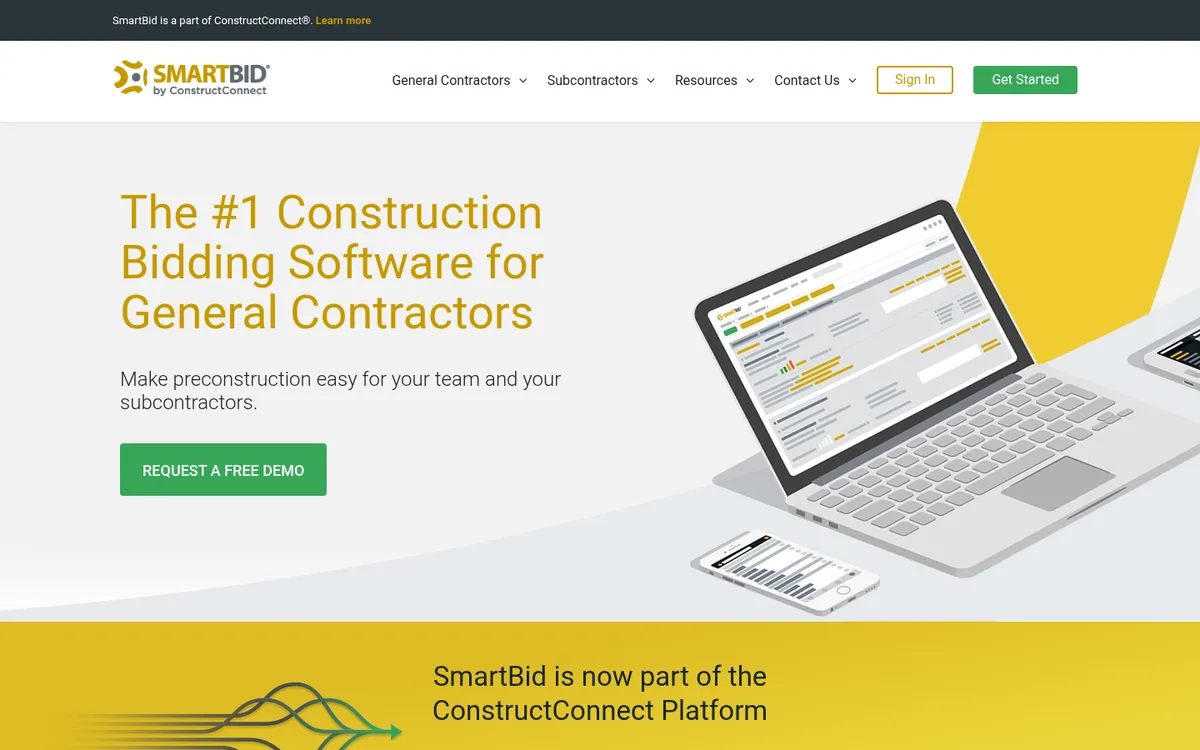
SmartBid is bid management software for general contractors, now part of ConstructConnect. It is where a GC keeps its subcontractor database, sends invitations to bid, runs prequalification with ConsensusDocs 721 and compares bids side by side in BidTabs. It also searches the ConstructConnect subcontractor network and public agency data for new bidders.
Strictly, it is a tool for sending out bids rather than finding them. Subcontractors invited through SmartBid get access at no cost.
Best for: General contractors who send out many bid packages and want a clean subcontractor database.
Watch out for: Annual licenses only, and no published prices.
Pricing: Annual license per user, by quote. Free for invited subcontractors.
10. Bidspeed – Best for Government Bids With Proposal Help
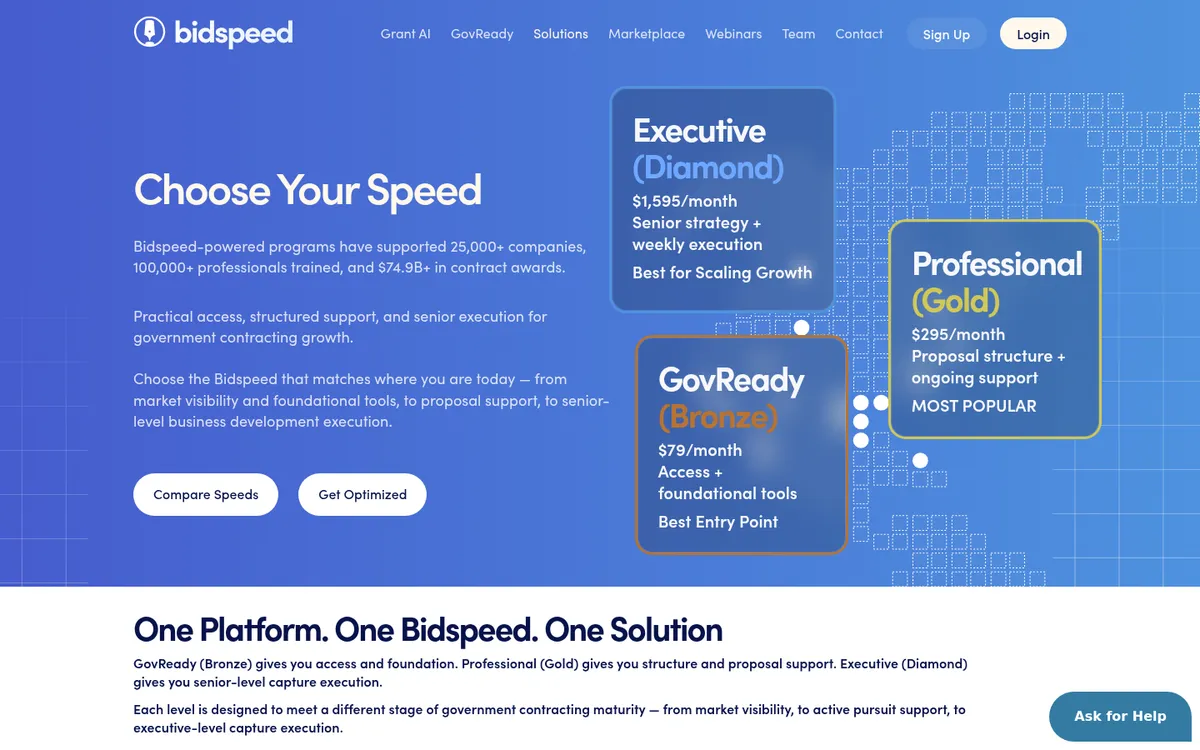
Bidspeed combines government bid search across federal, state and local agencies with training, proposal templates and advisory support. It is not construction-specific, but construction firms new to public work use it to find solicitations and get help writing compliant responses.
Best for: Small businesses that want guidance on government contracting as well as bid alerts.
Watch out for: You pay for the advisory service. If you only want bid alerts, SAM.gov and BidNet Direct cost less.
Pricing: GovReady (Bronze) $79 a month, Professional (Gold) $295 a month, Executive (Diamond) $1,595 a month.
11. Bid Ocean – Best for Trade Contractors Tracking Local Public Bids
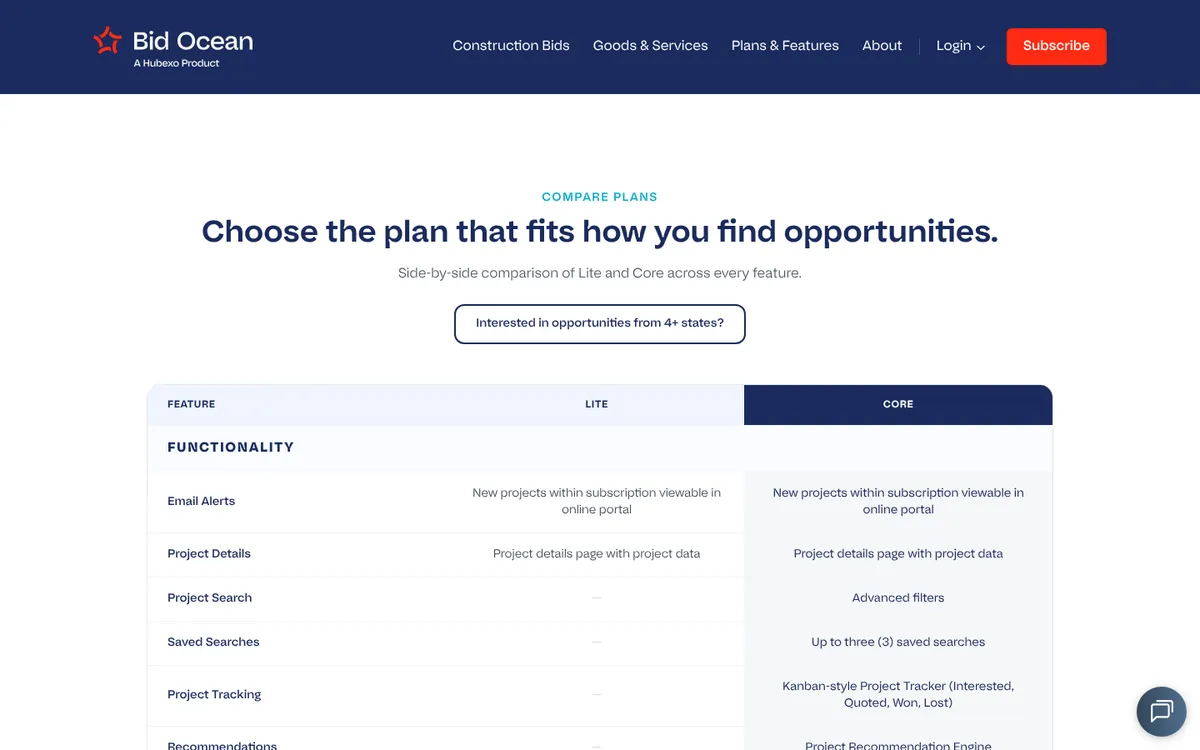
Bid Ocean was relaunched in July 2026 by Hubexo North America as a lead platform for public construction, goods and services, and design opportunities. Hubexo describes it as the first phase of a roadmap that will add private bidding opportunities later. You get project details, owner and plan holder contacts, bid results and email alerts by trade and state.
Best for: Trade contractors who want alerts for public bids in a few states.
Watch out for: Private projects are not covered yet, and prices are not shown in the plan comparison.
Pricing: Lite and Core plans covering up to three states, priced by the number of states. Larger coverage is by quote.
12. BidCentral – Best for British Columbia Projects
BidCentral lists public and private construction projects in British Columbia, from pre-bid and permits through tender awards, with a plan room, bid calendar and a directory of more than 10,000 contractors. It is useful only if you work in BC.
Best for: General contractors and subcontractors working in British Columbia.
Watch out for: Coverage is limited to one Canadian province.
Pricing: Free tier with project viewing, bid calendar and opportunity matching. Premium is $875 a year (Canadian site), with a 40% discount for members of regional construction associations.
13. Biddingo – Best for Canadian Public Sector Bids
Biddingo is an e-tendering portal used by Canadian public sector buyers. Free registration lets you search opportunities from Biddingo network clients, get weekly alerts and download bid packages, some free and some for a one-time fee. Premium Plus adds researched bids from other public bodies, daily bid notices and document downloads at no extra charge where available.
Best for: Contractors bidding municipal and provincial work in Canada.
Watch out for: Some agencies still charge separately for their documents.
Pricing: Free registration. Premium Plus is CA$250 a year, as shown on Biddingo’s bid pages.
14. Buildertrend – Best for Residential Builders Managing Leads and Proposals
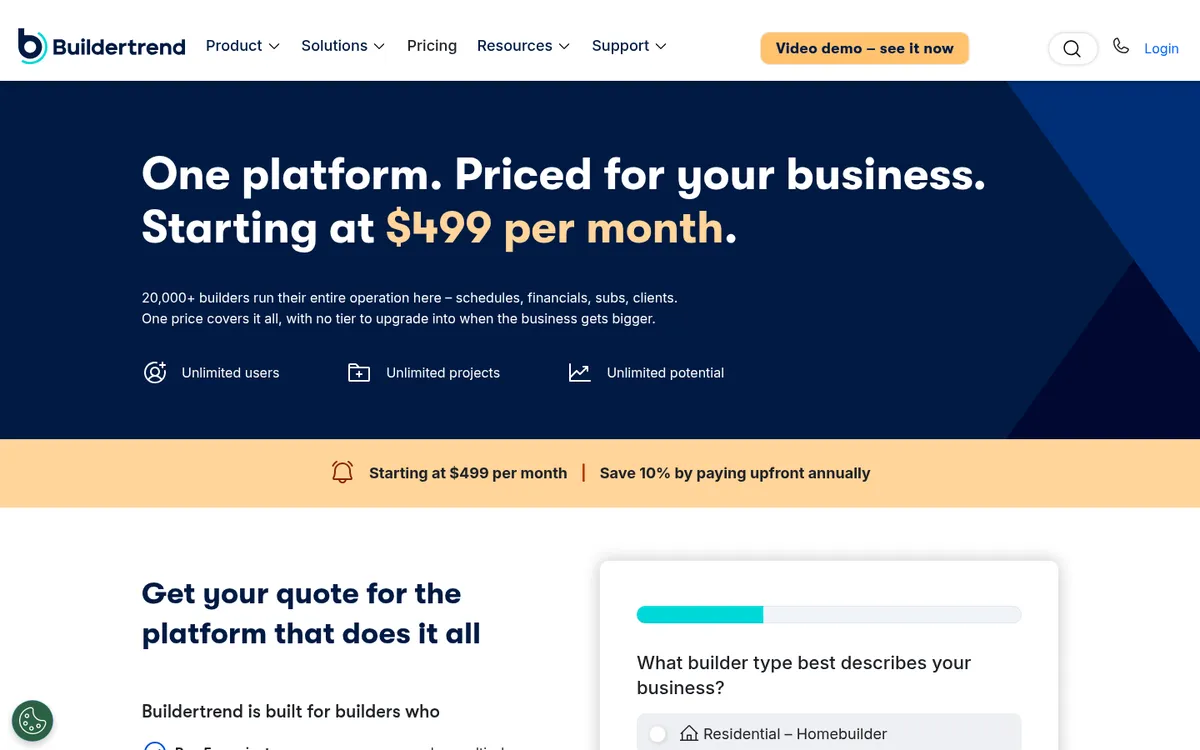
Buildertrend is not a bidding site: it will not find you projects. It is construction management software for home builders and remodelers, with lead tracking, proposals, scheduling and client communication. It earns a place here because many residential builders use it to manage the leads and bids they win through other channels.
If you are comparing it with cost control software, see Buildertrend vs Planyard and our list of Buildertrend alternatives.
Best for: Residential builders and remodelers who want leads, proposals and client communication in one system.
Watch out for: It is a monthly software cost, not a lead source, and it is a large system for a small team.
Pricing: From $499 a month, with 10% off when you pay annually upfront.
How We Chose and Checked These Sites
We started from the sites in the previous version of this guide and checked each one in October 2026: whether it still runs under the same name, what it covers, and the price on its own website. Three sites have merged into others since the last update: BidClerk and CMD Group into ConstructConnect, and Governmentbids.com into BidNet Direct. Where a provider does not publish a price, we say so instead of quoting a third-party estimate. We refresh this list twice a year.
How to Make a Winning Bid Sheet for Construction Projects
A clear, accurate bid sheet shows the owner you understand the job and have priced it properly.
1. Thoroughly Review the Project Details
Before drafting your bid sheet, study the project requirements, including:
- Drawings and technical specifications.
- Project timelines and deadlines.
- Specific client expectations or unusual site conditions.
Reading these closely makes sure your bid matches what the owner asked for.
2. Provide a Detailed Cost Breakdown
Organize your costs into clear categories such as:
- Labor: wages, hours and subcontractor fees.
- Materials: quantities and unit prices.
- Equipment: rental or maintenance costs.
- Overhead: administration, permits and contingencies.
Tools like Planyard handle the calculations and markups, so fewer costs slip through.
3. Incorporate a Project Timeline
Include a clear schedule for project milestones, such as:
- Start and completion dates.
- Key deliverables at each phase.
- Time allowed for approvals and client feedback.
A realistic schedule shows the owner you have thought about how the job will run.
4. Highlight Your Qualifications
Give the owner reasons to trust you:
- Similar projects you have completed.
- Licenses, bonding and certifications the job requires.
- Specialist skills or equipment that set your team apart.
5. Use Professional Formatting
Start with a construction bid template and keep the layout simple:
- Clear headings and sections.
- A cover page that summarizes your proposal.
- A clean PDF export rather than a spreadsheet.
6. Customize for Each Project
Tailor each bid to the job: local costs, the client’s preferences and any special requirements.
7. Include Terms and Conditions
Spell out the scope of work, payment terms and exclusions. A clear terms section protects both sides and heads off disputes later.
8. Review and Proofread
Before submission:
- Check calculations and spelling.
- Make sure all required information is included.
- Confirm you have followed the bid instructions.
Already Winning Work? Manage Your Project Finances with Planyard
Planyard is not a bidding site or a lead generation tool, and it will not find you new projects. It helps once you have won the work: budgets, purchase orders, subcontractor payments and cost tracking.
If you find and win projects through the sites above, Planyard picks up from there. Turn the winning bid into a live project budget, raise purchase orders against it, and track every cost as invoices come in. Pricing starts at $105 per project manager per month (Essential); purchase orders are on Professional ($158) and subcontractor pay applications on Ultimate ($210). There is a 14-day free trial. See our construction bidding software page for how estimating and bids work in Planyard.
"If I were still relying solely on Excel to track and present the financial positions of our projects, I would be losing significant time every single month. By implementing the streamlined processes that Planyard supports, I’m saving at least three to four days of work every month that would have otherwise been spent on manual data entry and reconciliation."
Read more
Convert Bids into Live Project Budgets
Winning the bid is the first step. Planyard converts your estimate into a project budget without re-keying it, then links every purchase order, subcontract and invoice back to the original numbers, so you always know where you stand against what you priced.
Track Costs in Real Time
As invoices arrive and subcontractor pay applications are approved, the budget updates. You see committed cost, actual spend and forecast final cost for every line, without building a spreadsheet.
Manage Subcontractor Payments
On the Ultimate plan, subcontractors submit pay applications directly through Planyard. You review and approve, and the approved amount syncs to your accounting software.
Sync with Your Accounting Software
Planyard integrates with QuickBooks, Xero and Sage from the Essential plan. Approved costs flow into your ledger, so nobody types them in twice.
"I would say Planyard is a great way to easily and conveniently track all your job costs in one place. It allows you to compare your projections against real-time costs while streamlining subcontractor bids; you can receive those bids, import them directly into the software, and track them effortlessly as the project progresses."
Read more
Conclusion
The right bidding site depends on the work you want. SAM.gov, PlanHub, BuildingConnected and the free tiers of BidNet Direct and BidCentral cost nothing and cover a lot of public and GC-led work. ConstructConnect, Dodge and ConstructionWire cost more and earn it when you want private projects before the bidder list is set.
Start with the free sites for your trade and area, track which ones bring work you actually win, and pay for a database only when you know what you need from it. Once the bids turn into projects, Planyard keeps the costs in line with what you priced.
Already winning work? Keep your project finances under control.
Planyard is not a lead generation tool. It turns won bids into live budgets, tracks costs and handles subcontractor payments. 14-day free trial.