
Choosing a JCT form can feel a bit like standing in front of a wall of light switches and hoping you guess the right one. Standard Building? Design and Build? Intermediate? Minor Works? It’s all “JCT”, but the choice you make at the start quietly controls risk, admin and, ultimately, margin for the whole job.
This article is the practical companion to the broader overview in JCT Contracts Explained: Types, Payment Terms, and How to Manage Them in Practice. Here the goal is simple: help contractors, QSs and project managers pick the right JCT contract type for a project, and understand what that choice means for cost control and day-to-day workflows.
We’ll look at the main JCT families, walk through a simple decision path you can use when you’re pricing or negotiating, compare the types side by side, and then tie it all back to how you actually run the contract in software rather than in a heroic spreadsheet.
The JCT families you’ll actually see on real projects
JCT publishes a lot of documents, but in everyday contracting the same forms keep coming back. It’s worth knowing roughly what each one is “for” before getting lost in clause numbers.
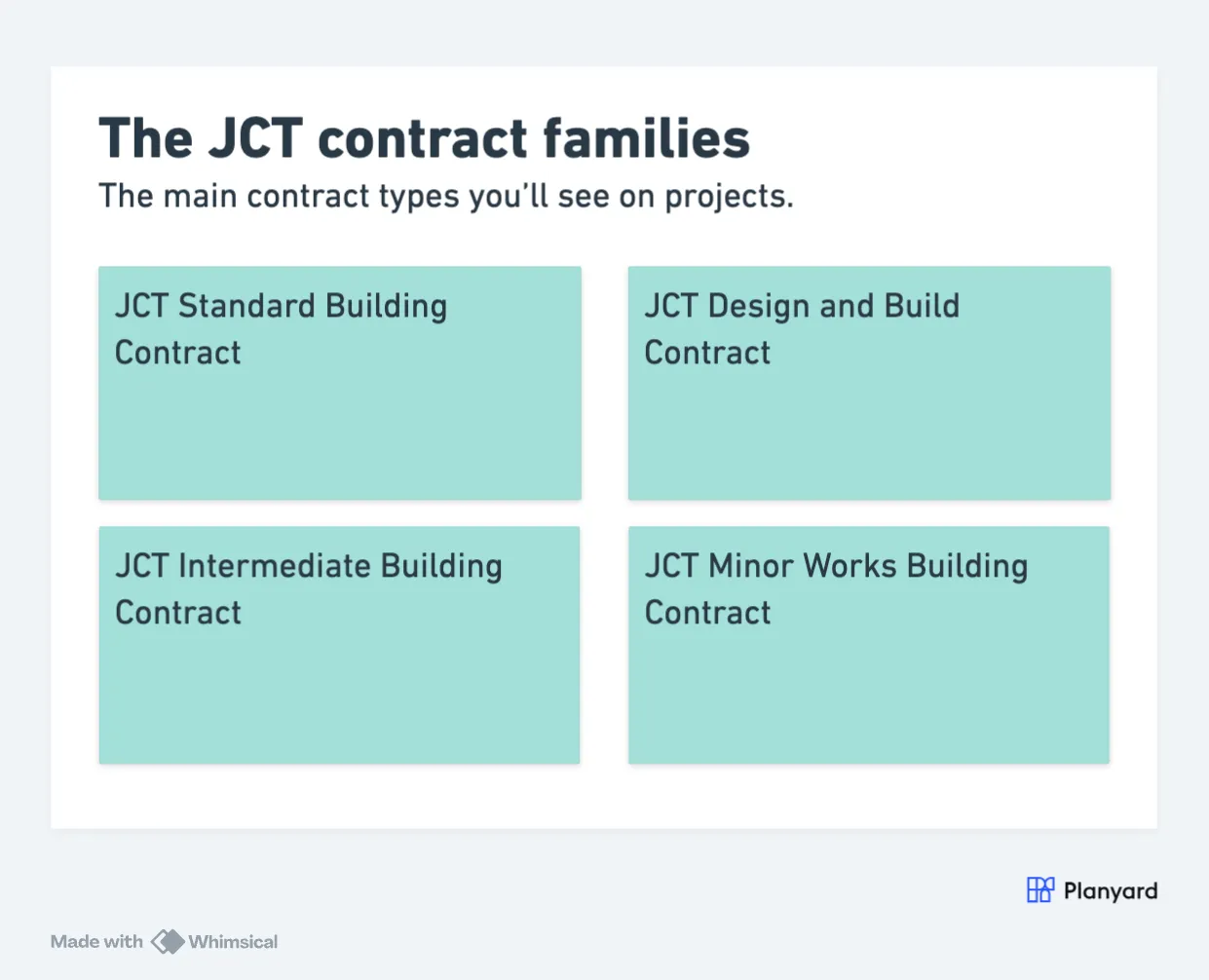
The JCT Standard Building Contract is the classic traditional form. The employer’s team leads the design; the main contractor builds in accordance with drawings, specifications and often bills of quantities. It shines on medium to large, more complex projects where the client wants strong control over design and quality. From the contractor’s side, it brings detailed procedures for payment, valuation and variations – great for structure, demanding on admin. We dig into the commercial detail in JCT Standard Building Contract: Key Clauses That Affect Cost Control.
The JCT Design and Build Contract shifts things. Here the contractor takes responsibility for both design and construction (subject to the Employer’s Requirements and the Contractor’s Proposals). Clients like the “single point of responsibility”; contractors like the chance to coordinate design and build more tightly, but they also inherit more design risk. Variations and scope creep can be particularly spicy. There’s a full breakdown of that dynamic in JCT Design and Build: How to Manage Design Risk and Variations.
The JCT Intermediate Building Contract sits in the middle. It’s for projects that are a bit too involved for a simple Minor Works contract but don’t justify the full complexity of Standard Building. Think small to medium projects with some specialist work but not a huge number of bespoke clauses. It gives you more structure than Minor Works without the full administrative weight of Standard Building. You’ll find more on that in JCT Intermediate Contract: When It Fits and How to Administer It.
The JCT Minor Works Building Contract is, unsurprisingly, meant for minor works: smaller, straightforward projects, refurbs and fit-outs with simple design and a limited number of trades. It’s shorter, simpler and quicker to get agreed. That doesn’t mean it’s risk-free. A single badly managed variation or a messy final account can hurt a small project more than a big one. We talk about how to keep these projects under control without drowning them in paperwork in JCT Minor Works: Keeping Small Projects Under Control Without Overkill.
There are other forms – management contracts, major project forms, homeowner contracts and so on – but for most construction businesses, those four are the daily bread. If you want the high-level overview of all of them in one place, start with JCT Contracts Explained: Types, Payment Terms, and How to Manage Them in Practice, then come back here for choices.
A simple way to think about JCT contract types
When you strip away the legalese, choosing between JCT forms comes down to a few questions:
- How big and complex is the project?
- Who should carry design responsibility?
- How much procedure do you want in payment and change control?
- How sophisticated are the parties (and their admin capacity)?
You don’t need an actual flow chart to use that logic, but you can think about it as a rough path.
If the project is small and straightforward, with simple design and a few trades, Minor Works is usually the natural starting point. Pushing a small job into a Standard Building Contract can be like using a cruise ship to cross a canal. On the other hand, forcing something genuinely complex into Minor Works just because “it’s shorter” tends to lead to gaps that get filled with arguments.
If the project is medium or large and the employer wants to retain control of design with a consultant team, then you’re normally choosing between Intermediate and Standard Building. Intermediate works where the complexity is modest and the parties want structure but not full-blown mega-contract territory. Standard Building makes more sense where you have detailed documents, multiple packages and a higher risk of disputes if you don’t follow a clear playbook.
If the employer wants one party to take responsibility for both design and construction, or the contractor is best placed to coordinate complex design, then Design and Build comes into play. It suits projects where buildability, sequencing and contractor-led design input are key. It also suits clients who don’t want to manage lots of interfaces but are comfortable paying for that convenience via the contract risk profile.
You can mix in other considerations – funder requirements, sector norms, how familiar the project team is with each form – but those four questions will already get you to a sensible short list.
If you’re used to NEC or other forms and want to see how JCT contract types sit within the wider standard form landscape, JCT vs NEC: Which Contract Works Better for Cost Control and Payment Certainty? is a good comparison.
JCT contract types side by side
Sometimes a table tells the story faster than a thousand words. Here’s a simple view of the main JCT construction contracts from a contractor/QS perspective:
| JCT contract form | Typical project size / complexity | Design responsibility | Typical use case | Cost tracking & risk implications | Admin load |
|---|---|---|---|---|---|
| Standard Building Contract | Medium to large, higher complexity | Employer-led design (consultant team), contractor builds | Traditional projects with detailed drawings, specs and bills of quantities | Strong procedures for valuation and variations; good protection if you follow the processes, but lots to track | High – detailed certifications, variations and payment process |
| Design and Build Contract | Medium to large, often complex or bespoke | Contractor takes on both design and construction | “Single point responsibility” projects where client wants one main contract | More design and coordination risk on contractor; variations can be more complex and higher-value | High – strong focus on scope, design risk and change control |
| Intermediate Building Contract | Small to medium, some complexity | Usually employer-designed, with some specialist work | Projects too involved for Minor Works but lighter than Standard Building | Reasonable structure for valuations and change without full heavy machinery; easier to administer than Standard | Medium – more structure than Minor Works, less than Standard |
| Minor Works Building Contract | Small, straightforward projects | Simple, usually employer-designed | Refurbishments, fit-outs, small new builds with limited complexity | Less contractual structure, so you rely more on good habits for variations and records | Low – shorter contract, simpler procedures |
This table doesn’t replace reading the contracts, obviously, but it’s useful when you’re scoping or pricing and trying to work out what you’re signing up for commercially.
Each of these forms has its own quirks. We go into those more deeply in the specific guides:
- JCT Standard Building Contract: Key Clauses That Affect Cost Control
- JCT Design and Build: How to Manage Design Risk and Variations
- JCT Minor Works: Keeping Small Projects Under Control Without Overkill
- JCT Intermediate Contract: When It Fits and How to Administer It
How your JCT choice affects tendering and pricing
The JCT form isn’t just something the legal team cares about. It directly shapes how you should price and structure your tender.
Under a Standard Building Contract, you’re often pricing against detailed drawings and bills of quantities. That encourages tight rates and makes remeasurement or valuation more structured, but it also means gaps in the documentation can come back to haunt either party. You want to be very clear on what’s included, what’s provisional, and how you’ll handle design development. A contract like this pairs naturally with a more granular internal cost structure and clear variation logs.
On a Design and Build job, the risk shifts. You might be tendering against Employer’s Requirements and offering Contractor’s Proposals. Design development and buildability tweaks are where you can win or lose margin. The contract type tells you that more of the “unknowns” sit with you: coordination, clashes, certain types of change. That should show up in your allowances, risk contingencies and the way you qualify your tender. It should also show up in how you plan to track design-related variations internally, because the contract gives you less sympathy if you simply “didn’t realise” something was your risk.
With Intermediate and Minor Works, pricing can sometimes be a bit looser. There may be fewer documents, more “standard” assumptions and less formal structure. That can feel refreshing, but it means your own documents and records carry more weight. If you’re using a simpler JCT form, think of your internal templates and checklists as the missing structure.
Whatever the form, the payment provisions matter. The way due dates, final dates and notices are set up in JCT can influence how you plan your cashflow and how aggressive you can be on payment terms. For a closer look at that side of things, see JCT Payment Terms and Timeline: A Simple Guide (with Examples).
How JCT types change your valuations, variations and admin burden
Once the project starts, the differences between JCT forms show up in the rhythm of valuations and variations.
On a Standard Building job, you might be running monthly valuations based on measured work and agreed variations against a bill of quantities. That means lots of line items, lots of measurement, and plenty of opportunities for small discrepancies to become big arguments. The upside is that the contract gives you a clear structure for handling them, as long as you keep up your side of the paperwork.
On a Design and Build project, valuations can be more milestone- or activity-based, with larger chunks of value tied to stages of work and design deliverables. Variations may be more complex, because a single design change can ripple into multiple packages. The contract doesn’t magically organise that complexity for you; your internal processes and tools do.
In Intermediate and Minor Works, things are simpler on paper. Fewer clauses, fewer procedures, fewer formal hoops to jump through. The risk is that “simpler” quietly turns into “looser”, and that important changes never make it into a proper log or agreement. That’s where checklists, variation logs and standardised payment applications really matter, because the contract itself is not going to remind you.
If you’re working under other standard forms alongside JCT, the differences become even more pronounced. NEC, for example, approaches change and payment very differently. If that’s your world, JCT vs NEC: Which Contract Works Better for Cost Control and Payment Certainty? is worth a look, because your admin and software setup needs to flex accordingly.
JCT 2016, JCT 2024 and keeping your playbook up to date
To keep things interesting, JCT doesn’t stand still. New editions come out, such as the JCT 2016 suite and the more recent JCT 2024 updates. The overall flavour of the contracts stays familiar, but the details move: payment provisions, insurance options, wording around design, digital information and so on.
Those changes can make a difference when you’re comparing forms and planning your commercial strategy. For example, tweaks to payment terms, notice requirements or risk allocation can change which form feels tolerable on a given job.
You don’t need to memorise all the differences, but you do need to know when you’re looking at an updated form and what that means in practice. That’s exactly what we cover in JCT 2024: Key Changes for Contractors, QSs and Cost Control.
How your JCT form affects your software workflow
On paper, JCT doesn’t care whether you manage it with a ring binder, a spreadsheet or a full project cost system. In reality, your choice of contract type does affect the kind of tools that make sense.
On a complex Standard Building or Design and Build project, you’ll typically have:
- A larger contract sum with more moving parts
- A higher volume of variations, both small and large
- More stakeholders involved in valuations and decisions
That’s the sort of environment where a dedicated contract and cost management system really pays off. You want a place where the main contract sum, each variation, every application and every certificate live together in a way the whole team can see. That’s the job of tools like JCT Contract Management Software for Contractors and QSs.
On more modest Intermediate and Minor Works projects, you might be tempted to stick to Excel because “it’s only a small job”. The risk is that you end up running as many small contracts in spreadsheets as you would run big ones in software, just with less structure. Even there, a lightweight setup that pulls together contract sums, variations and payment applications can save a lot of time and reduce arguments.
Payment cycles are a good example. Instead of juggling calendars and email reminders for due dates, payment notices and pay less notices under different JCT forms, you can push that logic into a system that tracks applications, notices and certifications automatically. That’s the idea behind Automate JCT Payment Applications and Notices: the contract rules stay the same, but the admin work shrinks.
The nice part is that most of these tools don’t care which specific JCT form you use. You configure the contract once – sum, retention, key dates, maybe some tags to say “this is D&B” vs “this is Minor Works” – and then run through a standard workflow. The software doesn’t replace the need to understand the contract, but it does stop you from reinventing the same processes by hand on every project.
Where to look next
If you’re in the “what JCT form should we actually use?” stage right now, you’re in the right article. Once you’ve narrowed that down, the next steps tend to be:
Getting the big picture of how JCT works in practice:
https://planyard.com/blog/jct-contracts-explained/
Understanding how your chosen form handles payment and cash flow:
https://planyard.com/blog/jct-payment-terms-timeline/
Diving deeper into the specific contract type you’re about to sign:
https://planyard.com/blog/jct-standard-building-contract-cost-control/
https://planyard.com/blog/jct-design-and-build-variations/
https://planyard.com/blog/jct-minor-works-contract-guide/
https://planyard.com/blog/jct-intermediate-contract-guide/
Making sure your playbook matches the latest edition:
https://planyard.com/blog/jct-2024-changes-cost-control/
And finally, when you’re ready to stop running all of this in Excel and email:
https://planyard.com/jct-contract-management-software/
https://planyard.com/jct-payment-application-software/
The JCT form you choose is the starting position, not the whole game. How you track cost, change and payment on top of that choice is where most of the real-world wins and losses happen.